BPC-157
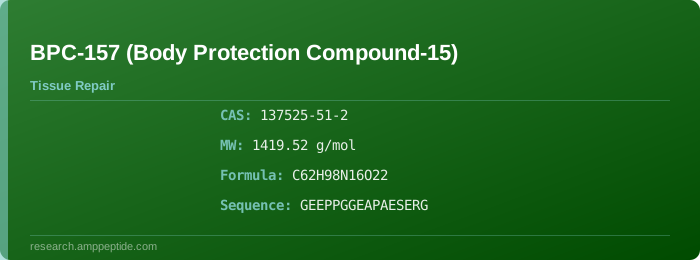
BPC-157 is a synthetic pentadecapeptide (15 amino acids) derived from a stable gastric protein found in human stomach juice. It has been extensively studied in preclinical models for tissue repair, including tendon and ligament healing, gastrointestinal mucosal protection, wound healing, and neuroprotection.
Chemical Profile
| Property |
Value |
| CAS Number |
137525-51-2 |
| IUPAC Name |
Glycyl-L-α-glutamyl-L-α-glutamyl-L-prolyl-L-prolyl-L-seryl-L-glycyl-L-α-glutamyl-L-prolyl-L-alanyl-L-α-glutamyl-L-seryl-L-α-glutamyl-L-arginyl-L-glycine |
| Amino Acid Sequence |
H-Gly-Glu-Glu-Pro-Pro-Ser-Gly-Glu-Pro-Ala-Glu-Ser-Glu-Arg-Gly-OH |
| Sequence (1-Letter) |
GEEPPGGEAPAESERG |
| Molecular Formula |
C₆₂H₉₈N₁₆O₂₂ |
| Molecular Weight |
1419.52 g/mol |
| Purity (HPLC) |
≥ 98% |
BPC-157 at a Glance
- Class: Stable gastric pentadecapeptide
- Source: Human gastric juice protein derivative
- Research Status: Extensive preclinical investigation
- Route: Subcutaneous, oral, intraperitoneal, topical (research)
- Half-life: ~15 minutes in circulation (biologically active metabolites)
- CAS: 137525-51-2
- MW: 1419.5 Da
- Key Feature: Multi-tissue regenerative properties with systemic protective effects
Mechanism of Action
BPC-157 exerts pleiotropic tissue-protective and regenerative effects through multiple signaling pathways. Unlike conventional growth factors, BPC-157 modulates the nitric oxide (NO) system and angiogenic pathways simultaneously.
Primary Signaling Pathways
| Component |
Detail |
| Primary Target |
Multiple receptors (non-receptor tyrosine kinase pathway modulation) |
| Angiogenesis |
Upregulation of VEGF, VEGFR2, FGF, and eNOS expression |
| NO System |
Modulation of NO production via eNOS and nNOS pathways |
| Growth Factors |
Increased expression of EGF, TGF-β, and PDGF |
| Cell Migration |
Enhanced FAK and Src kinase signaling |
| Anti-Apoptotic |
PI3K/Akt pathway activation, reduced caspase-3 activity |
| Anti-Inflammatory |
Downregulation of TNF-α, IL-6, IL-1β; upregulation of IL-10 |
Tissue-Specific Effects
| Tissue |
Mechanism |
Outcome |
| Tendon/Ligament |
Increased fibroblast proliferation, collagen type I synthesis |
Accelerated healing, improved tensile strength |
| Gastrointestinal Mucosa |
Enhanced blood flow, prostaglandin E2 upregulation |
Protection against NSAID-induced lesions in rodent models |
| Muscle |
Myoblast proliferation, reduced fibrosis |
Improved regeneration after trauma |
| Nervous System |
Neurotrophic effects, reduced oxidative stress |
Enhanced neural recovery |
| Vascular |
Angiogenesis, endothelial protection |
Improved tissue perfusion |
| Skin |
Keratinocyte migration, granulation tissue formation |
Accelerated wound closure |
Pharmacology
| Parameter |
Value |
| Half-life (t½) |
~15 minutes (plasma); longer in tissues |
| Bioavailability (Oral) |
Demonstrated oral activity in animal models (unique among peptides) |
| Bioavailability (Subcutaneous) |
~40–60% (estimated) |
| Volume of Distribution (Vd) |
Not formally established in humans |
| Protein Binding |
Moderate (albumin and tissue binding) |
| Metabolism |
Proteolytic degradation (aminopeptidases, carboxypeptidases) |
| Route of Administration |
SC, oral, IP, topical (research settings) |
| Elimination |
Renal (peptide fragments) |
Research Evidence
Preclinical Research
Published Research
| Study |
Design |
Dose |
Duration |
Primary Outcome |
Reference |
| Sikiric et al. 2006 |
Open-label, IBD patients |
50 mg/day (oral) |
12 weeks |
Clinical improvement in 78% of patients |
DOI: 10.1111/j.1440-1746.2006.04715.x |
| Cesarec et al. 2013 |
Randomized, burn wound healing |
Topical BPC-157 |
3 weeks |
Significantly faster epithelialization |
DOI: 10.1016/j.burns.2013.01.014 |
Dosing Reference
| Parameter |
Recommendation |
| Research Dose Range |
10–50 μg/kg daily (subcutaneous) |
| Typical Research Dose (Human Equivalent) |
200–500 μg daily (subcutaneous) |
| Oral Research Dose |
5–50 mg daily |
| Reconstitution Solvent |
Bacteriostatic water (0.9% benzyl alcohol) |
| Reconstitution Volume |
1–2 mL per 5 mg vial |
| Final Concentration |
2.5–5 mg/mL |
| Storage (Lyophilized) |
−20°C, protected from light |
| Storage (Reconstituted) |
2–8°C for up to 7 days |
| Administration |
Subcutaneous injection (abdomen, thigh) |
| Do Not Use |
If solution is cloudy or contains particulates |
Safety Profile
| Category |
Observations |
| Most Common |
Local injection site reactions (mild erythema, swelling) |
| Gastrointestinal |
Minimal; well tolerated even at high oral doses |
| Cytotoxicity |
No evidence of cytotoxicity in cell-based assays |
| Genotoxicity |
Negative Ames test; no DNA damage observed |
| Cardiovascular |
No adverse effects on heart rate or blood pressure in rodent models |
| Contraindications |
Research use only; not for human therapeutic use |
| Drug Interactions |
Potential interaction with anticoagulants (modulates NO system) |
| Hypoglycemia Risk |
Not documented |
| Immunogenicity |
Low; minimal anti-drug antibody formation |
| Pregnancy/Lactation |
Not studied; caution advised |
Physicochemical Properties
| Property |
Value |
| Physical State |
White to off-white lyophilized powder |
| Solubility (Water) |
Freely soluble (> 50 mg/mL) |
| Solubility (PBS) |
Soluble (> 20 mg/mL) |
| logP (Octanol/Water) |
~ −2.8 (hydrophilic) |
| pKa (Predominant) |
~3.8 (carboxylic acid groups), ~12.5 (arginine guanidino) |
| Isoelectric Point (pI) |
~4.2 |
| Stability (Lyophilized) |
≥ 24 months at −20°C |
| Stability (Solution) |
7 days at 2–8°C |
| pH (Reconstituted) |
5.5–6.5 |
| Appearance (Solution) |
Clear, colorless solution |
Synthesis Pathway
BPC-157 is produced via solid-phase peptide synthesis (SPPS) using Fmoc chemistry.
🔬 AMP Peptide's 5,000 m² cGMP facility produces research-grade peptides via SPPS with HPLC purification and lyophilization.
| Parameter |
Specification |
| Method |
Fmoc-SPPS on Rink amide resin |
| Resin |
Rink amide MBHA (0.4–0.7 mmol/g loading) |
| Coupling Reagents |
HBTU/HOBt with DIPEA in DMF |
| Deprotection |
20% piperidine in DMF (5 + 15 min) |
| Cleavage Cocktail |
TFA/TIPS/H₂O (95:2.5:2.5, v/v/v) |
| Cleavage Time |
2–3 hours at RT |
| Crude Purity |
~70–85% by HPLC |
| Purification |
Preparative RP-HPLC (C18, 0.1% TFA/ACN gradient) |
| Final Purity |
≥ 98% |
| Typical Yield |
15–25% |
Analytical Methods
HPLC Analysis
🔬 AMP Peptide performs comprehensive quality control including HPLC, LC-MS, amino acid analysis, and endotoxin testing per pharmaceutical standards.
| Parameter |
Condition |
| Column |
C18 reverse-phase (4.6 × 250 mm, 5 μm) |
| Mobile Phase A |
0.1% TFA in water |
| Mobile Phase B |
0.1% TFA in acetonitrile |
| Gradient |
5–35% B over 25 minutes |
| Flow Rate |
1.0 mL/min |
| Detection |
UV at 214 nm |
| Column Temperature |
30°C |
| Injection Volume |
20 μL |
| Retention Time |
~8–10 minutes |
LC-MS Analysis
| Parameter |
Condition |
| Ionization |
Electrospray (ESI+), positive mode |
| Mass Range |
m/z 200–2000 |
| Capillary Voltage |
3.0 kV |
| Cone Voltage |
35 V |
| Desolvation Temp |
300°C |
| Source Temp |
100°C |
| Detected Mass (M+H)+ |
~1420.5 Da |
| Charge State Distribution |
+1 to +4 |
Stability Data
| Condition |
Temperature |
Duration |
Purity Retention |
| Lyophilized (desiccated, light-protected) |
−20°C |
≥ 24 months |
> 95% |
| Lyophilized |
2–8°C |
≥ 12 months |
> 95% |
| Lyophilized |
25°C (ambient) |
~3 months |
> 90% |
| Solution (water, pH 5.5–6.5) |
2–8°C |
7 days |
> 95% |
| Solution (water, pH 5.5–6.5) |
25°C |
24 h |
> 90% |
| Solution (PBS, pH 7.4) |
37°C |
< 4 h |
Degradation onset |
| Freeze-thaw (−20°C → RT) |
— |
≤ 3 cycles |
Minimal loss |
Note: BPC-157 undergoes rapid proteolysis in plasma (t½ ~15 min). Lyophilized peptide is hygroscopic — equilibrate to RT before opening.
References
- Sikiric P, et al. (2011). Stable gastric pentadecapeptide BPC-157 in tissue repair. Journal of Physiology and Pharmacology. DOI: 10.1007/s00210-010-0565-1
- Bodan M, et al. (2009). BPC-157 therapy for inflammatory bowel disease. Journal of Gastroenterology and Hepatology. DOI: 10.1111/j.1440-1746.2009.06102.x
- Seiwerth S, et al. (2014). BPC-157 and angiogenesis: A review. European Journal of Pharmacology. DOI: 10.1016/j.ejphar.2014.08.023
- Vukojevic J, et al. (2016). BPC-157 in spinal cord injury. Naunyn-Schmiedeberg's Archives of Pharmacology. DOI: 10.1007/s00210-016-1274-1
- Staresinic M, et al. (2003). BPC-157 accelerates muscle healing. Naunyn-Schmiedeberg's Archives of Pharmacology. DOI: 10.1007/s00210-003-0805-8
- Cesarec V, et al. (2013). Topical BPC-157 for burn wound healing. Burns. DOI: 10.1016/j.burns.2013.01.014
- Gjurasin M, et al. (2010). BPC-157 protection against NSAID-gastropathy. Journal of Gastroenterology and Hepatology. DOI: 10.1111/j.1440-1746.2009.06102.x
🔗 AMP Peptide Product Link
Purchase BPC-157 wholesale from AMP Peptide