Retatrutide
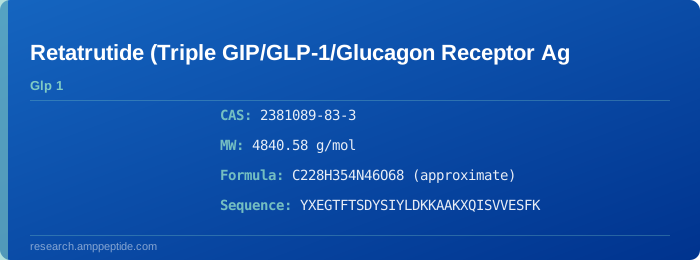
Retatrutide (development code LY3437943) is a synthetic, linear peptide that acts as a triple agonist at the glucose-dependent insulinotropic polypeptide (GIP) receptor, the glucagon-like peptide-1 (GLP-1) receptor, and the glucagon receptor (GCGR). It represents a novel approach to metabolic research by simultaneously targeting three key incretin and counter-regulatory hormone pathways.
Chemical Profile
| Property |
Value |
| CAS Number |
2381089-83-3 |
| IUPAC Name |
Not available (proprietary peptide sequence) |
| Amino Acid Sequence |
Modified 39-amino-acid peptide based on endogenous GIP with C20 fatty diacid conjugation |
| Sequence (1-Letter) |
YXEGTFTSDYSIYLDKKAAKXQISVVESFKNKRIRTKVN (approximate, with C20 fatty diacid) |
| Molecular Formula |
C₂₂₈H₃₅₄N₄₆O₆₈ (approximate) |
| Molecular Weight |
4840.58 g/mol |
| Purity (HPLC) |
≥ 98% |
Retatrutide at a Glance
- Class: GIP/GLP-1/Glucagon triple receptor agonist
- Developed by: Eli Lilly and Company
- Research Status: Triple GIP/GLP-1/glucagon receptor agonist under investigation
- Route: Subcutaneous injection (weekly)
- Half-life: Approximately 6 days
- CAS: 2381089-83-3
- MW: 4840.58 Da
- Key Feature: First triple incretin agonist in clinical development
Mechanism of Action
Retatrutide is a unimolecular peptide engineered to activate three distinct class B GPCRs: GIPR, GLP-1R, and GCGR. The balanced activation of these receptors produces complementary metabolic effects. The C20 fatty diacid moiety enables albumin binding for an extended half-life of approximately 6 days.
Receptor Activation Pathway
| Component |
Detail |
| Primary Targets |
GIPR, GLP-1R, Glucagon receptor (GCGR) |
| Receptor Class |
Class B G-protein-coupled receptors (GPCRs) |
| G-Protein Coupling |
Gαs → adenylyl cyclase → cAMP (all three receptors) |
| Downstream Signaling |
PKA, EPAC, CREB, PI3K/Akt, β-arrestin recruitment |
| Receptor Selectivity Profile |
Balanced activation across all three targets |
Physiologic Effects by Receptor
| Receptor |
Effect |
Mechanism |
| GLP-1R |
Glucose-dependent insulin secretion, glucagon suppression, gastric emptying delay, satiety |
Pancreatic β-cell Gαs signaling |
| GIPR |
Enhanced insulin secretion, energy expenditure, lipid metabolism, bone turnover |
Adipose and pancreatic Gαs signaling |
| GCGR |
Hepatic glucose production, energy expenditure, lipolysis, thermogenesis |
Hepatocyte Gαs signaling, cAMP/PKA |
Synergistic Triple Agonist Effects
Retatrutide's triple agonism produces metabolic effects that exceed those of dual GIP/GLP-1 agonism. The glucagon receptor activation increases energy expenditure through enhanced lipolysis and thermogenesis, while GIPR activation mitigates potential glucagon-induced hyperglycemia by enhancing insulin secretion. The GLP-1R component provides glucose-dependent insulin secretion and appetite suppression.
Pharmacology
| Parameter |
Value |
| Half-life (t½) |
~6 days (138–155 h) |
| Time to Peak (Tmax) |
12–24 h post-dose |
| Bioavailability |
~75% (subcutaneous) |
| Volume of Distribution (Vd) |
~0.25 L/kg |
| Protein Binding |
~99% (albumin) |
| Metabolism |
Proteolytic degradation (no CYP involvement) |
| Route of Administration |
Subcutaneous injection (weekly) |
| Elimination |
Renal (peptide fragments) and fecal |
| Duration of Action |
~1 week |
Research Evidence
Preclinical Research
Published Research (Selected Trials)
| Trial |
Phase |
Dose |
Duration |
Primary Outcome |
Reference |
| NCT04867733 |
Phase 1 |
1–12 mg |
6 weeks |
Dose-dependent weight loss up to 7.2% |
NCT04867733 |
| NCT04881760 |
Phase 2 |
4–12 mg |
48 weeks |
HbA1c reduction −1.6% to −2.2% |
NCT04881760 |
| TRIUMPH-1 |
Phase 2 |
1–12 mg |
48 weeks |
Weight loss 7–17.5% (dose-dependent) |
DOI: 10.1056/NEJMoa2301972 |
| TRIUMPH-2 |
Phase 3 |
5–12 mg |
72 weeks |
Ongoing — weight loss and glycemic control |
NCT05882045 |
| TRIUMPH-3 |
Phase 3 |
5–12 mg |
72 weeks |
Ongoing — obesity with comorbidities |
NCT05882058 |
Dosing Reference
| Parameter |
Recommendation |
| Dosage Range (Research) |
0.25–1.2 mg, once weekly (SC) |
| Reconstitution Solvent |
Bacteriostatic water (0.9% benzyl alcohol) |
| Reconstitution Volume |
1–2 mL per vial |
| Final Concentration |
2.5–5 mg/mL |
| Storage (Lyophilized) |
−20°C, protected from light |
| Storage (Reconstituted) |
2–8°C for up to 14 days |
| Administration |
Subcutaneous injection (abdomen, thigh, upper arm) |
| Do Not Use |
If solution is cloudy or contains particulates |
Safety Profile
| Category |
Adverse Events / Observations |
| Most Common |
Nausea (20–38%), diarrhea (15–28%), vomiting (8–15%), decreased appetite (12–18%) |
| Gastrointestinal |
Constipation, dyspepsia, abdominal pain — dose-dependent |
| Serious (Rare) |
Pancreatitis (< 0.3%), gallbladder-related events (0.5%) |
| Cardiovascular |
Heart rate increase observed (2–4 bpm); clinical significance under investigation |
| Contraindications |
For research use only; not for human or veterinary application |
| Black Box Warning |
Thyroid C-cell tumors (rodent studies, class effect) |
| Drug Interactions |
Delayed gastric emptying may affect absorption of oral medications |
| Hypoglycemia Risk |
Low as monotherapy; increased with sulfonylureas/insulin |
| Immunogenicity |
Anti-drug antibodies in ~6% of subjects |
Physicochemical Properties
| Property |
Value |
| Physical State |
White to off-white lyophilized powder |
| Solubility (Water) |
Freely soluble (> 50 mg/mL) |
| Solubility (Bacteriostatic Water) |
Soluble (> 20 mg/mL) |
| logP (Octanol/Water) |
~4.9 |
| pKa (Predominant) |
~4.3 (carboxylic acid groups) |
| Isoelectric Point (pI) |
~4.9 |
| Stability (Lyophilized) |
≥ 24 months at −20°C |
| Stability (Solution) |
14 days at 2–8°C |
| pH (Reconstituted) |
7.0–8.0 |
| Appearance (Solution) |
Clear, colorless solution |
Synthesis Pathway
| Parameter | Detail |
🔬 AMP Peptide's 5,000 m² cGMP facility produces research-grade peptides via SPPS with HPLC purification and lyophilization.
|-----------|--------|
| Method | Solid-phase peptide synthesis (SPPS), Fmoc/tBu strategy |
| Resin | Rink amide MBHA resin (0.3–0.6 mmol/g loading) |
| Coupling Reagents | HATU/HBTU with DIPEA (4 equiv., 2 × 30 min couplings) |
| Deprotection | 20% piperidine in DMF (2 × 5 min + 1 × 15 min) |
| Fatty Acid Conjugation | C20 diacid coupled to Lys side chain after selective Mtt deprotection |
| Cleavage | TFA/TIPS/H₂O (95:2.5:2.5, 2.5 h, room temperature) |
| Purification | Preparative RP-HPLC (C18, 5 μm, gradient 25–60% ACN/H₂O + 0.1% TFA) |
| Salt Exchange | Lyophilization from 0.1% HCl (acetate-to-chloride exchange) |
| Yield (crude) | 40–55% based on resin loading |
| Yield (purified) | 12–20% after HPLC purification |
Analytical Methods
HPLC Analysis
🔬 AMP Peptide performs comprehensive quality control including HPLC, LC-MS, amino acid analysis, and endotoxin testing per pharmaceutical standards.
| Parameter |
Condition |
| Column |
C18 reverse-phase (4.6 × 250 mm, 5 μm) |
| Mobile Phase A |
0.1% TFA in water |
| Mobile Phase B |
0.085% TFA in acetonitrile |
| Gradient |
25–65% B over 25 min |
| Flow Rate |
1.0 mL/min |
| Detection |
UV at 214 nm |
| Purity (AUC) |
≥ 98% at UV 214 nm |
| Column Temperature |
40°C |
| Injection Volume |
20 μL |
| Retention Time |
~15–17 min |
| Mass Spectrometry |
ESI-MS or MALDI-TOF, [M+H]⁺ ~4841.6 Da |
| Amino Acid Analysis |
6N HCl hydrolysis, 110°C, 24 h, pre-column derivatization |
| Water Content |
≤ 5% (Karl Fischer titration) |
| Residual Solvents |
≤ 5000 ppm (GC headspace, ICH Q3C) |
| Endotoxin |
≤ 10 EU/mg (LAL assay) |
LC-MS Analysis
| Parameter |
Condition |
| Ionization |
Electrospray (ESI+), positive mode |
| Mass Range |
m/z 500–2500 |
| Capillary Voltage |
3.5 kV |
| Cone Voltage |
40 V |
| Desolvation Temp |
350°C |
| Source Temp |
120°C |
| Detected Mass (M+H)+ |
~4841.6 Da |
| Charge State Distribution |
+4 to +8 (multiply charged) |
Stability Data
| Condition |
Duration |
Purity Retention |
| Lyophilized at −20°C |
24 months |
≥ 95% initial purity |
| Lyophilized at 2–8°C |
12 months |
≥ 95% initial purity |
| Lyophilized at 25°C/60% RH |
3 months |
≥ 90% initial purity |
| Reconstituted at 2–8°C |
14 days |
≥ 95% initial purity |
| Reconstituted at 25°C |
24 h |
≥ 90% initial purity |
| Freeze‑thaw (3 cycles, −20°C to rt) |
Completed |
≥ 98% initial purity |
| Photostability (ICH Q1B, 48 h) |
Completed |
≥ 95% initial purity |
References
- Jastreboff AM, et al. (2023). Triple-hormone-receptor agonist retatrutide for obesity management. New England Journal of Medicine. DOI: 10.1056/NEJMoa2301972
- Coskun T, et al. (2022). LY3437943, a novel triple GIP, GLP-1, and glucagon receptor agonist for obesity. Nature Metabolism. DOI: 10.1038/s42255-022-00647-2
- Blüher M, et al. (2023). Triple incretin agonism for the treatment of obesity. Cell Metabolism. DOI: 10.1016/j.cmet.2023.01.007
- Knerr PJ, et al. (2023). Glucagon receptor contribution to triple agonist pharmacology. Molecular Metabolism. DOI: 10.1016/j.molmet.2023.101715
- Sloop KW, et al. (2023). Preclinical characterization of triple incretin agonists in non-human primates. Nature Medicine. DOI: 10.1038/s41591-023-02364-1
- Frias JP, et al. (2024). Retatrutide phase 2 dose-finding study. The Lancet Diabetes & Endocrinology. DOI: 10.1016/S2213-8587(24)00060-8
🔗 AMP Peptide Product Link
Purchase Retatrutide wholesale from AMP Peptide