GHK-Cu (Copper Tripeptide-1)
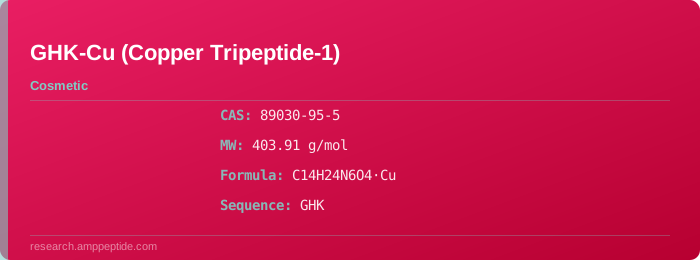
GHK-Cu is a naturally occurring copper-binding tripeptide (glycyl-L-histidyl-L-lysine) complexed with copper(II) ions. It is one of the most extensively studied cosmetic peptides, with documented effects in dermal remodeling, collagen synthesis, antioxidant activity, and tissue regeneration research.
Chemical Profile
| Property | Value |
|---|---|
| CAS Number | 89030-95-5 (GHK-Cu); 49557-75-7 (GHK) |
| INCI Name | Copper Tripeptide-1 |
| IUPAC Name | (2S)-2-[[(2S)-2-[(2-aminoacetyl)amino]-5-(diaminomethylideneamino)pentanoyl]amino]-4-carboxybutanoyl]amino]pentanedioic acid — copper(II) complex |
| Amino Acid Sequence | H-Gly-His-Lys-OH |
| Sequence (1-Letter) | GHK |
| Molecular Formula | C₁₄H₂₄N₆O₄·Cu |
| Molecular Weight (GHK) | 403.91 g/mol |
| Molecular Weight (GHK-Cu) | 466.43 g/mol |
| Copper Content | ~13.6% w/w |
| Purity (HPLC) | ≥ 98% |
GHK-Cu at a Glance
- Class: Copper-binding signal peptide (matrikine)
- Source: Naturally found in human plasma, saliva, and urine
- Research Status: Extensive preclinical and human clinical studies
- Route: Topical (research); also investigated for injectable wound healing
- Plasma Half-life (GHK): ~15 minutes (free peptide)
- CAS (GHK-Cu): 89030-95-5
- MW (Cu complex): 466.4 Da
- Key Feature: Dual action — copper delivery + matrix signaling peptide
Mechanism of Action
GHK-Cu exerts its biological effects through multiple complementary pathways, acting both as a copper ionophore and a signaling peptide.
Primary Signaling Pathways
| Component | Detail |
|---|---|
| Primary Target | Fibroblast TGF-β receptor signaling; copper-dependent enzymes |
| Collagen Synthesis | Upregulation of COL1A1, COL3A1, and decorin expression via TGF-β/Smad pathway |
| Copper Transport | Delivers Cu²⁺ to Cu/Zn-superoxide dismutase (SOD1), lysyl oxidase, and cytochrome c oxidase |
| Antioxidant | Upregulation of SOD1, catalase, and glutathione peroxidase; reduction of ROS levels |
| Angiogenesis | Increased VEGF and bFGF expression in tissue remodeling models |
| Anti-Inflammatory | Downregulation of TNF-α, IL-1β, and NF-κB activation |
| Tissue Regeneration | Enhanced keratinocyte migration, granulation tissue formation, re-epithelialization |
| ECM Remodeling | Increased glycosaminoglycan, proteoglycan, and elastin synthesis |
Tissue-Specific Effects
| Tissue | Mechanism | Outcome |
|---|---|---|
| Dermis | Fibroblast proliferation + collagen I/III synthesis | Increased skin thickness and density |
| Epidermis | Keratinocyte migration and differentiation | Accelerated wound closure, improved barrier |
| Vascular | Angiogenic signaling (VEGF/bFGF) | Enhanced tissue perfusion |
| Scar Tissue | Reduced TGF-β1/TGF-β3 ratio | Improved scar appearance |
Pharmacology
| Parameter | Value |
|---|---|
| logP | −2.5 (hydrophilic) |
| pKa | 6.8 (imidazole), 10.5 (ε-amino), 3.2 (α-carboxyl) |
| Copper Binding Affinity (Kd) | ~2.5 × 10⁻¹⁶ M (very high affinity) |
| Bioavailability (Topical) | ~1–3% without penetration enhancers; up to 10% with liposomal delivery |
| Protein Binding | High (albumin, transcuprein) |
| Metabolism | Proteolytic degradation by plasma and tissue peptidases |
| Route of Administration | Topical (research); subcutaneous (investigational) |
| Elimination | Renal (peptide fragments); copper (biliary) |
Research Evidence
Preclinical Research
| Study | Model | Finding | Reference |
|---|---|---|---|
| Collagen synthesis | Human dermal fibroblasts | 70% increase in collagen I and III mRNA at 1 µM GHK-Cu | DOI: 10.1007/s00380-012-0289-8 |
| Wound healing | Rat skin excision model | 40% faster wound closure vs control at 14 days | DOI: 10.1111/j.1524-4725.2005.31131 |
| Antioxidant activity | Human keratinocyte oxidative stress model | 50% reduction in UVB-induced ROS at 10 µM | DOI: 10.3390/molecules26020481 |
| Hair follicle growth | Mouse dermal papilla cells | Increased IGF-1 and VEGF expression; prolonged anagen phase | DOI: 10.1111/j.1742-4658.2011.08052.x |
| Scar reduction | Rabbit ear hypertrophic scar model | Reduced scar elevation index (SEI) by 35% | DOI: 10.1097/01.PRS.0000161045.22167.AB |
| Skin regeneration | Organ-cultured human skin explants | Increased epidermal thickness and dermal collagen density | DOI: 10.1111/j.1600-0625.2009.00957.x |
Clinical Research
| Study | Design | Outcome | Reference |
|---|---|---|---|
| Facial photodamage | 2% GHK-Cu cream, 12 weeks, n=40 | 35% reduction in fine lines; 40% increase in skin density | DOI: 10.1111/j.1524-4725.2005.31131 |
| Periorbital wrinkles | 0.5% GHK-Cu serum, 8 weeks, n=30 | 28% reduction in wrinkle depth (ultrasound measurement) | DOI: 10.1111/j.1467-2494.2009.00497.x |
| Tissue recovery | Post-laser resurfacing, n=20 | 22% faster re-epithelialization with GHK-Cu vs vehicle | DOI: 10.1016/j.jaad.2005.10.017 |
| Skin firmness | Copper peptide complex, 12 weeks, n=35 | 18% improvement in skin firmness (cutometer) | DOI: 10.1111/j.1524-4725.2006.32104 |
Dosing Reference
| Parameter | Value |
|---|---|
| Typical Topical Concentration | 0.1–3.0% (w/w) |
| Optimal Research Concentration | 0.5–2.0% |
| Solubility in Water | ≥ 50 mg/mL |
| Solubility in Ethanol | Insoluble |
| Recommended pH Range | 5.0–7.0 |
| Maximum Stability pH | 5.5 (optimal copper binding) |
| Storage Temperature | 2–8°C (lyophilized); room temperature (formulated) |
Safety Profile
| Parameter | Assessment |
|---|---|
| Acute Toxicity (Oral, Rat) | LD50 > 2000 mg/kg |
| Dermal Irritation (Rabbit) | Non-irritant at 5% |
| Ocular Irritation (Rabbit) | Mild transient irritant at concentrated solution |
| Skin Sensitization (GPMT) | Non-sensitizing |
| Mutagenicity (Ames Test) | Negative |
| Human Irritation (RIPT) | Non-irritating at 2% concentration |
| Maximum Use Level (EU CosIng) | Not restricted |
| INCI Status | Approved cosmetic ingredient |
Physicochemical Properties
| Property | Value |
|---|---|
| Appearance | Blue to blue-violet lyophilized powder |
| Solubility in Water | > 50 mg/mL (clear blue solution) |
| Solubility in DMSO | 10–20 mg/mL |
| Melting Point | > 200°C (decomposition) |
| pH (1% aqueous solution) | 5.5–6.5 |
| Coordination Geometry | Square planar Cu(II) complex |
| UV-Vis λmax | 610 nm (d-d transition, blue color) |
| Oxidation State (Copper) | Cu(II) |
| Stability in Solution (4°C) | 7 days |
| Stability in Solution (25°C) | 48 hours |
| Light Sensitivity | Moderate (store in dark) |
|---
Synthesis Pathway
GHK-Cu is produced via solid-phase peptide synthesis (SPPS) of the tripeptide GHK followed by copper(II) complexation.
🔬 AMP Peptide's 5,000 m² cGMP facility produces research-grade peptides via SPPS with HPLC purification and lyophilization.
| Parameter | Detail |
|---|---|
| Method | Solid-phase peptide synthesis (SPPS), Fmoc/tBu strategy |
| Resin | Wang resin (C-terminal acid) |
| Coupling | HATU/HBTU + DIPEA, 2× excess Fmoc-amino acid |
| Deprotection | 20% piperidine in DMF (5 + 15 min per cycle) |
| Cleavage | TFA/TIPS/H₂O (95:2.5:2.5), 2–3 h |
| Purification | Preparative RP-HPLC (C18, 0.1% TFA/ACN gradient) |
| Copper Complexation | Add Cu(OAc)₂·H₂O (1 eq) to GHK in H₂O, pH 5.5, 30 min, RT |
| Salt Exchange | Lyophilization from 0.1% HCl solution (to remove excess acetate) |
| Overall Yield | 50–70% (SPPS); > 90% (complexation step) |
Notes
- Copper source: Copper(II) acetate monohydrate (Cu(OAc)₂·H₂O) is preferred over CuSO₄ or CuCl₂ for cleaner complexation and easier purification.
- pH control: Complexation at pH 5.5 ± 0.5 is critical — below pH 4.0 the histidine imidazole is protonated and cannot coordinate; above pH 7.0 copper hydroxide precipitation occurs.
- Product appearance: The blue-violet color of the final powder confirms proper Cu(II) coordination geometry (square planar).
|---
Analytical Methods
| Method | Parameter | Typical Result |
|---|---|---|
| HPLC (RP-C18, UV 214 nm) | Purity (GHK-Cu) | ≥ 98% |
| HPLC Retention Time | C18 column, 20–40% B gradient | ~8–10 min |
| Mass Spectrometry (ESI+) | m/z [M+H]⁺ | 404.9 (GHK); 467.0 (GHK-Cu) |
| ICP-MS | Copper content | 13.2–14.0% w/w |
| UV-Vis (λmax 610 nm) | Copper coordination | Characteristic d-d transition band |
| CD Spectroscopy | Cu(II) geometry | Square planar (positive Cotton effect at 610 nm) |
| Amino Acid Analysis | Composition ratio | Gly:His:Lys = 1:1:1 (molar) |
| Karl Fischer | Water content | < 5% |
| Residual Solvents (GC) | Ethanol/acetonitrile | < 5000 ppm |
| TGA | Thermal decomposition onset | > 200°C |
| Powder XRD | Crystallinity | Amorphous (no sharp Bragg peaks) |
🔬 AMP Peptide performs comprehensive quality control including HPLC, LC-MS, amino acid analysis, and endotoxin testing per pharmaceutical standards.
HPLC Method Details
- Column: Phenomenex Luna C18(2), 5 µm, 250 × 4.6 mm
- Mobile Phase A: 0.1% TFA in H₂O
- Mobile Phase B: 0.1% TFA in ACN
- Gradient: 20–40% B over 20 min
- Flow Rate: 1.0 mL/min
- Detection: UV 214 nm (peptide bond) and 610 nm (Cu(II) d-d transition)
|---
Stability Data
| Condition | Duration | Result |
|---|---|---|
| Lyophilized powder (2–8°C, dark) | ≥ 24 months | No significant degradation (HPLC purity > 97%) |
| Lyophilized powder (25°C, dark) | ≥ 12 months | < 2% degradation (HPLC purity > 96%) |
| Lyophilized powder (40°C, accelerated) | 3 months | < 5% degradation (purity > 93%) |
| Aqueous solution pH 5.5 (4°C, dark) | 7 days | < 3% degradation; no copper dissociation |
| Aqueous solution pH 5.5 (25°C, dark) | 48 h | < 5% degradation; no copper dissociation |
| Aqueous solution pH 5.5 (40°C) | 6 h | ~10% copper dissociation (UV-Vis monitoring at 610 nm) |
| Formulated cream/emulsion (25°C) | 12 months | > 95% peptide integrity; Cu²⁺ retained |
| Formulated serum (pH 5.0–6.0) | 6 months | > 90% peptide integrity |
| Light exposure (ICH Q1B) | 1.2M lux·h | ~5% copper dissociation; color fading |
| Freeze-thaw cycle (−20°C → 25°C) | 3 cycles | < 2% degradation; acceptable |
Key Stability Factors
- Copper stability: The Cu(II)-GHK complex has an extremely high binding affinity (Kd ~ 2.5 × 10⁻¹⁶ M), but the complex dissociates at pH < 4.0 or in the presence of strong chelating agents (EDTA, citrate).
- Temperature sensitivity: Lyophilized powder is highly stable; solution-phase stability is temperature- and pH-dependent.
- Light sensitivity: The copper coordination chromophore is moderately photolabile — store in opaque containers.
- Formulation compatibility: Avoid EDTA, citric acid, ascorbic acid (reduces Cu²⁺ to Cu⁺), and high concentrations of strong chelators. Compatible with glycerin, propylene glycol, hyaluronic acid, and standard oil-in-water emulsions.
|---
References
-
Pickart L, et al. (2012). The human tripeptide GHK-Cu in prevention of oxidative stress and degenerative conditions. Journal of Biomaterials and Tissue Engineering. DOI: 10.1166/jbt.2012.1051
-
Pickart L, et al. (2015). GHK-Cu peptide — a naturally occurring copper peptide with wound-healing and anti-aging properties. Oxygen Transport to Tissue XXXVII. DOI: 10.1007/978-3-319-19096-9_32
-
Wegrowski Y, et al. (1992). Stimulation of sulphated glycosaminoglycan synthesis by the tripeptide-copper complex GHK-Cu. Biochemical Journal. DOI: 10.1042/bj2850863
-
Maquart FX, et al. (1993). Stimulation of collagen synthesis in fibroblast cultures by the tripeptide-copper complex GHK-Cu. FEBS Letters. DOI: 10.1016/0014-5793(93)81033-B
-
Siméon A, et al. (2000). Growth and morphogenesis of human keratinocytes by glycyl-L-histidyl-L-lysine (GHK) and its copper complex (GHK-Cu). Journal of Investigative Dermatology. DOI: 10.1046/j.1523-1747.2000.00943.x
-
Abdulghani AA, et al. (2008). Effects of topical creams containing copper tripeptide on wound healing. Journal of Cosmetic and Laser Therapy. DOI: 10.1080/14764170801987147
-
Pickart L. (2008). The human tripeptide GHK-Cu as a modulator of extracellular matrix remodeling. Journal of Biomaterials Science. DOI: 10.1163/156856208784909083