GHRP-6
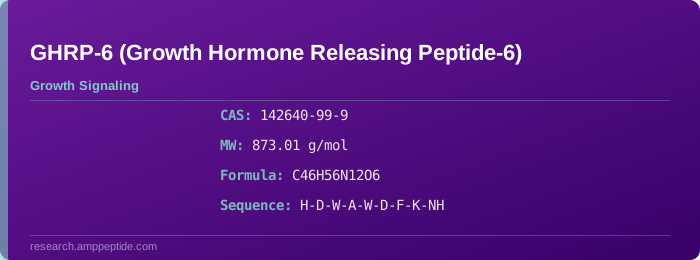
GHRP-6 (Growth Hormone Releasing Peptide-6) is a synthetic hexapeptide growth hormone secretagogue (GHS) and the prototypical member of the GHRP family. First described in the 1980s, it was the first peptide GHS to demonstrate oral bioavailability and potent GH-releasing activity in humans, establishing the foundation for subsequent GHRP development.
Chemical Profile
| Property |
Value |
| CAS Number |
142640-99-9 |
| IUPAC Name |
(2S)-1-[(2S)-2-[[(2S)-2-[[(2R)-2-[[(2R)-2-acetamido-3-(1H-indol-3-yl)propanoyl]amino]-5-(diaminomethylideneamino)pentanoyl]amino]-3-(1H-indol-3-yl)propanoyl]amino]-5-(diaminomethylideneamino)pentanoyl]pyrrolidine-2-carboxamide |
| Amino Acid Sequence |
His-D-Trp-Ala-Trp-D-Phe-Lys-NH₂ |
| Sequence (1-Letter) |
H-D-W-A-W-D-F-K-NH₂ |
| Molecular Formula |
C₄₆H₅₆N₁₂O₆ |
| Molecular Weight |
873.01 g/mol |
| Purity (HPLC) |
≥ 98% |
GHRP-6 at a Glance
- Class: Hexapeptide GHSR-1a agonist
- First Described By: Bowers CY (Tulane University, 1984)
- Research Status: Extensive preclinical; limited clinical
- Route: Subcutaneous, intranasal, oral (research)
- Half-life: ~30 minutes
- CAS: 142640-99-9
- MW: 873.0 Da
- Key Feature: First-generation GHRP; historical benchmark
Mechanism of Action
GHRP-6 is a potent GHSR-1a agonist. As the prototypical GHRP, its mechanism has been extensively characterized and serves as the reference standard for comparing later-generation secretagogues.
Primary Signaling Pathways
| Component |
Detail |
| Primary Target |
GHSR-1a |
| Potency |
EC50 ~2–5 nM |
| Signaling |
Gαq/11 → PLC → IP₃ → Ca²⁺ |
| GH AUC Increase |
5- to 15-fold |
| Prolactin |
Significant elevation (30–50% of GH effect) |
| Cortisol |
Mild to moderate elevation |
| Appetite |
Potent appetite stimulation |
Physiologic Effects
| System |
Effect |
Mechanism |
| Pituitary |
GH secretion |
GHSR-1a |
| Hypothalamus |
GHRH ↑, somatostatin ↓ |
Dual regulation |
| Appetite |
Strong stimulation |
Ghrelin-like |
| Metabolism |
Anabolic effect |
GH/IGF-1 |
| Glucose |
Transient elevation |
GH anti-insulin effect |
Pharmacology
| Parameter |
Value |
| Half-life (t½) |
~30 minutes |
| Bioavailability (SC) |
~70–80% |
| Bioavailability (Oral) |
~5–10% |
| Tmax |
~15–20 min |
| Volume of Distribution (Vd) |
~0.4 L/kg |
| Protein Binding |
Moderate |
| Metabolism |
Proteolytic |
| Route |
SC, intranasal, oral |
| Elimination |
Renal |
Research Evidence
Dosing Reference
| Parameter |
Recommendation |
| Research Dose Range |
100–300 μg per injection |
| Frequency |
2–3 times daily |
| Duration |
8–16 weeks |
| Reconstitution |
1–2 mL bacteriostatic water |
| Storage (Lyophilized) |
−20°C |
| Storage (Reconstituted) |
2–8°C (7 days) |
Safety Profile
| Category |
Observations |
| Most Common |
Injection site reactions, increased appetite, transient facial flushing |
| Endocrine |
Prolactin and cortisol elevation |
| Contraindications |
Research use only |
| Immunogenicity |
Low |
Physicochemical Properties
| Property |
Value |
| Physical State |
White lyophilized powder |
| Solubility (Water) |
Freely soluble (> 50 mg/mL) |
| logP |
~ −1.0 |
| pI |
~10.8 |
| Stability (Lyophilized) |
≥ 24 months at −20°C |
Synthesis Pathway (SPPS)
GHRP-6 (His-D-Trp-Ala-Trp-D-Phe-Lys-NH₂) is a synthetic hexapeptide produced by Fmoc-based solid-phase peptide synthesis. Its longer sequence (6 amino acids, including two Trp and one His residue) requires careful handling of indole and imidazole side-chain protection.
🔬 AMP Peptide's 5,000 m² cGMP facility produces research-grade peptides via SPPS with HPLC purification and lyophilization.
| Step |
Description |
| 1. Resin Loading |
Fmoc-Lys(Boc)-OH loaded onto Rink amide MBHA resin (0.3–0.5 mmol/g) |
| 2. Fmoc Deprotection |
20% piperidine in DMF (2 × 5 min, 1 × 15 min); monitored by Kaiser test |
| 3. Coupling Cycle (×5) |
Fmoc-D-Phe-OH, Fmoc-Trp(Boc)-OH, Fmoc-Ala-OH, Fmoc-D-Trp(Boc)-OH, Fmoc-His(Trt)-OH coupled sequentially using HBTU/HOBt/DIPEA or HATU for sterically hindered couplings |
| 4. Coupling Monitoring |
Kaiser ninhydrin test after each cycle; recouple if positive |
| 5. Global Cleavage |
TFA/TIS/H₂O (95:2.5:2.5, v/v/v), 2.5 h at room temperature |
| 6. Precipitation |
Dropwise addition to cold MTBE/hexane (1:1); crude pellet isolated by centrifugation |
| 7. Purification |
Preparative RP-HPLC (C18, 15–50% MeCN in 0.1% TFA, 25 min gradient) |
| 8. Lyophilization |
Freeze-drying from glacial AcOH/H₂O (1:4) yields fluffy white powder |
Solid-Phase Support: Rink amide MBHA resin (100–200 mesh, substitution 0.3–0.5 mmol/g).
Side-Chain Protection: Lys(Boc), Trp(Boc), His(Trt). D-Trp and D-Phe use Fmoc-D-amino acid derivatives.
Crude Purity: ~70–80% by HPLC; purified yield ~35–45% after two prep-HPLC passes.
Identity Confirmation
| Method |
Acceptance Criterion |
| Amino Acid Analysis |
His 0.95–1.05, D-Trp 0.90–1.10, Ala 0.95–1.05, Trp 0.90–1.05, D-Phe 0.95–1.05, Lys 0.95–1.05 |
| HRMS (ESI+) |
[M+H]⁺ calcd. 873.4502; found within ±3 ppm |
| ¹H NMR (500 MHz) |
Two indole NH signals (Trp, D-Trp) at δ 10.2–10.4 ppm; His imidazole C₂-H at δ 8.6 ppm |
| Chiral HPLC |
D-Trp and D-Phe configuration confirmed; <0.5% L-enantiomer |
| Peptide Mapping |
Trypsin/Lys-C digest → LC-MS confirms all six amino acid positions |
Analytical Methods
HPLC Analysis
🔬 AMP Peptide performs comprehensive quality control including HPLC, LC-MS, amino acid analysis, and endotoxin testing per pharmaceutical standards.
| Parameter |
Condition |
| Column |
C18 reverse-phase (4.6 × 250 mm, 5 μm) |
| Mobile Phase A |
0.1% TFA in water |
| Mobile Phase B |
0.1% TFA in acetonitrile |
| Gradient |
15–50% B over 25 min |
| Flow Rate |
1.0 mL/min |
| Detection |
UV at 214 nm |
| Column Temperature |
30°C |
| Injection Volume |
20 μL |
| Retention Time |
~14–16 min |
LC-MS Analysis
| Parameter |
Condition |
| Ionization |
Electrospray (ESI+), positive mode |
| Mass Range |
m/z 200–1400 |
| Capillary Voltage |
3.0 kV |
| Cone Voltage |
35 V |
| Desolvation Temp |
350°C |
| Source Temp |
120°C |
| Detected Mass (M+H)+ |
~874.0 Da |
| Detected Mass (M+2H)²+ |
~437.5 Da |
Stability Data
Lyophilized Powder Stability
| Condition |
Duration |
Purity (HPLC) |
Appearance |
| −20°C (long-term) |
36 months |
≥ 98.0% |
White powder |
| 2–8°C (refrigerated) |
12 months |
≥ 96.0% |
White powder |
| 25°C / 60% RH (accelerated) |
3 months |
≥ 93.0% |
Pale yellow |
| 40°C / 75% RH (stress) |
1 month |
≥ 85.0% |
Yellow; Trp oxidation ~5% |
| Photostability (ICH Q1B) |
— |
≥ 93.0% |
Yellowing; Trp photo-oxidation |
Solution Stability (Reconstituted)
| Solvent |
Concentration |
Temperature |
Stability Window |
| Bacteriostatic water (0.9% BA) |
2.5 mg/mL |
2–8°C |
7 days |
| Bacteriostatic water (0.9% BA) |
2.5 mg/mL |
25°C |
12 hours |
| Sterile saline (0.9% NaCl) |
2.5 mg/mL |
2–8°C |
48 hours |
| PBS (pH 7.4) |
1 mg/mL |
37°C |
2 hours |
Degradation Pathways: GHRP-6 is notably susceptible to Trp photo-oxidation (kynurenine pathway) and His oxidation under light. The two Trp residues make it more light-sensitive than other GHRPs. Metabisulfite or ascorbic acid (0.1%) can be added as antioxidant stabilizers.
References
- Bowers CY, et al. (1984). GHRP-6: A potent GH-releasing peptide. Journal of Clinical Endocrinology & Metabolism. DOI: 10.1210/jcem.58.2.290
- Bowers CY, et al. (1994). GHRP-6 in humans: GH release and oral activity. Journal of Clinical Endocrinology & Metabolism. DOI: 10.1210/jcem.79.4.7962278
- Ghigo E, et al. (1998). Diagnostic use of GHRP-6. Journal of Clinical Endocrinology & Metabolism. DOI: 10.1210/jcem.83.6.4851
- Bowers CY, (1998). GHRP development: From GHRP-6 to GHRP-2. Journal of Clinical Endocrinology & Metabolism. DOI: 10.1210/jcem.83.1.4571
- Deghenghi R, et al. (1994). GHRP-6 structure-activity. Peptides. DOI: 10.1016/0196-9781(94)90180-5
🔗 AMP Peptide Product Link
Purchase GHRP-6 wholesale from AMP Peptide