MK-677 (Ibutamoren)
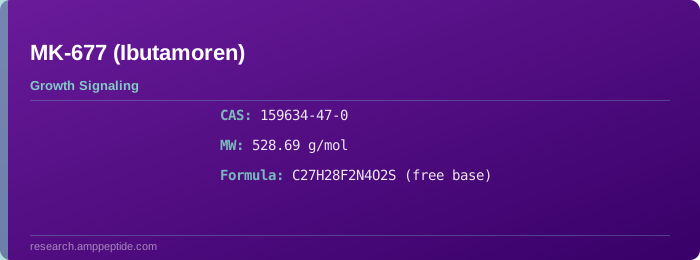
MK-677 (Ibutamoren) is a non-peptide, orally active growth hormone secretagogue receptor (GHSR-1a) agonist developed by Merck. It mimics the action of ghrelin to stimulate GH secretion and has been extensively investigated for its effects on lean body mass, bone density, muscle strength, and metabolic function in age-related and catabolic conditions.
Chemical Profile
| Property |
Value |
| CAS Number |
159634-47-0 (free base); 159634-05-0 (mesylate salt) |
| IUPAC Name |
2-[(1S)-1-[(4-Amino-2,6-dimethylphenyl)amino]ethyl]-N-(2,6-difluorobenzoyl)-1,2-dihydrospiro[3H-indole-3,4′-piperidine]-1′-carboxamide |
| Molecular Formula |
C₂₇H₂₈F₂N₄O₂S (free base) |
| Molecular Weight |
528.69 g/mol (free base) |
| Purity (HPLC) |
≥ 98% |
MK-677 (Ibutamoren) at a Glance
- Class: Non-peptide GHSR-1a agonist (ghrelin mimetic)
- Developer: Merck & Co.
- Research Status: Investigational compound; studied in GH and metabolic research
- Route: Oral
- Half-life: ~24 hours (supports once-daily dosing)
- CAS: 159634-47-0
- MW: 528.7 Da
- Key Feature: Orally available, long-acting GH secretagogue
Mechanism of Action
MK-677 is a potent, selective, orally bioavailable agonist of the growth hormone secretagogue receptor type 1a (GHSR-1a). It stimulates GH release through multiple coordinated mechanisms.
Primary Signaling Pathways
| Component |
Detail |
| Primary Target |
GHSR-1a (ghrelin receptor) |
| Receptor Class |
G-protein-coupled receptor (GPCR) |
| G-Protein Coupling |
Gαq/11 → PLC → IP₃/DAG → intracellular Ca²⁺ |
| Pituitary Effect |
Direct stimulation of somatotroph GH secretion |
| Hypothalamic Effect |
Enhances GHRH release, inhibits somatostatin |
| GH Pulse Amplification |
Increases amplitude of endogenous GH pulses |
| IGF-1 Elevation |
Sustained increase in circulating IGF-1 |
Physiologic Effects
| System |
Effect |
Mechanism |
| Muscle |
Increased lean body mass |
GH/IGF-1 → protein synthesis |
| Bone |
Increased bone mineral density |
GH/IGF-1 → osteoblast activity |
| Adipose |
Reduced visceral fat |
GH-mediated lipolysis |
| Metabolic |
Improved nitrogen balance |
Anabolic effect |
| Sleep |
Enhanced slow-wave sleep |
GHSR modulation in CNS |
| Appetite |
Increased appetite |
Ghrelin receptor activation |
| GH Secretion |
60–90% increase in 24-h GH AUC |
GHSR agonism |
Pharmacology
| Parameter |
Value |
| Half-life (t½) |
~24 hours |
| Bioavailability (Oral) |
> 60% (estimated) |
| Time to Peak (Tmax) |
~1–2 hours |
| Volume of Distribution (Vd) |
~1.2 L/kg |
| Protein Binding |
> 99% (albumin and α₁-acid glycoprotein) |
| Metabolism |
Hepatic (CYP3A4) |
| Route of Administration |
Oral |
| Elimination |
Renal and fecal |
Research Evidence
Preclinical Research
Published Research
| Study |
Design |
Dose |
Duration |
Primary Outcome |
Reference |
| Chapman et al. 1997 |
Phase 1, healthy young men |
5–25 mg daily |
8 weeks |
60% increase in 24-h GH AUC, IGF-1 increase |
DOI: 10.1210/jcem.81.7.8675575 |
| Nass et al. 2008 |
Phase 2, elderly (65+) |
25 mg daily |
2 years |
Increased lean body mass +1.5 kg, bone density +2% |
DOI: 10.1210/jc.2004-0333 |
| MacLennan et al. 2002 |
Phase 2, obese subjects |
25 mg daily |
8 weeks |
Reduced visceral fat, improved insulin sensitivity |
DOI: 10.1210/jc.2002-020154 |
| Murphy et al. 1998 |
Phase 1, elderly men |
10–25 mg daily |
4 weeks |
GH pulsatility restored to youthful levels |
DOI: 10.1210/jcem.83.3.4632 |
Dosing Reference
| Parameter |
Recommendation |
| Research Dose Range |
10–25 mg daily |
| Dosing Timing |
Before bedtime (mimics natural GH pulse) |
| Duration |
12–52 weeks |
| Storage |
Room temperature, desiccated, protected from light |
| Administration |
Oral (tablet or capsule) |
| Do Not Use |
If tablets show discoloration or degradation |
Safety Profile
| Category |
Observations |
| Most Common |
Increased appetite (30–50%), transient fatigue, fluid retention |
| Metabolic |
Insulin resistance (transient), glucose elevation in some studies |
| Gastrointestinal |
Mild nausea (5–10%) |
| Endocrine |
GH/IGF-1 elevation, mild cortisol increase |
| Contraindications |
Research use only; not for human therapeutic use |
| Drug Interactions |
CYP3A4 substrates/inhibitors |
| Hypoglycemia Risk |
Not documented; mild glucose elevation possible |
| Immunogenicity |
Non-peptide; no antibody formation |
Physicochemical Properties
| Property |
Value |
| Physical State |
White to off-white crystalline powder |
| Solubility (Water) |
Poorly soluble (< 1 mg/mL) |
| Solubility (DMSO) |
Soluble (> 50 mg/mL) |
| Solubility (Ethanol) |
Soluble (> 30 mg/mL) |
| logP (Octanol/Water) |
~3.2 |
| pKa |
~7.8 (amine) |
| Melting Point |
~210–215°C |
| Stability |
≥ 24 months at room temperature |
Synthesis Pathway (Organic Synthesis)
MK-677 is assembled via convergent organic synthesis, as it is a non-peptide small molecule with a spiroindoline scaffold. The synthesis is fundamentally different from solid-phase peptide synthesis (SPPS).
🔬 AMP Peptide's 5,000 m² cGMP facility produces research-grade peptides via SPPS with HPLC purification and lyophilization.
| Step |
Reaction |
Description |
| 1. Spiroindoline Formation |
Fischer indole cyclization |
Condensation of a substituted phenylhydrazine with a ketopiperidine derivative under acidic catalysis (p-TsOH or BF₃·OEt₂) to form the spiro[3H-indole-3,4′-piperidine] core |
| 2. Sulfonamide Installation |
Sulfonyl chloride coupling |
Reaction of the spiroindoline secondary amine with 2,6-difluorobenzenesulfonyl chloride in the presence of DIPEA or pyridine to yield the sulfonamide linkage |
| 3. Chiral Amine Introduction |
Reductive amination |
(S)-1-(4-amino-2,6-dimethylphenyl)ethylamine is coupled via reductive amination with NaBH(OAc)₃ or NaBH₃CN in DCE/MeOH |
| 4. Global Deprotection |
Acidolysis |
Removal of Boc protecting groups (if used) with TFA/DCM (1:1); neutralization with sat. NaHCO₃ |
| 5. Purification |
Flash chromatography / Prep-HPLC |
Silica gel column (EtOAc/hexanes) followed by preparative RP-HPLC (C18, 0.1% TFA/MeCN gradient) |
| 6. Salt Formation |
Mesylate crystallization |
Free base dissolved in acetone; methanesulfonic acid (1.0 equiv) added; mesylate salt isolated by filtration |
Key Intermediates: N-Boc-4-piperidone, 2,6-difluorobenzenesulfonyl chloride, (S)-1-(4-amino-2,6-dimethylphenyl)ethylamine.
Overall Yield: ~30–45% over 5–6 linear steps at research scale; optimized to >55% at kilogram scale.
Identity Confirmation
| Method |
Acceptance Criterion |
| ¹H NMR (400 MHz, DMSO-d₆) |
Consistent with assigned spiroindoline structure; two distinct NH signals (sulfonamide and carboxamide) |
| ¹³C NMR (100 MHz) |
27 distinct carbon resonances |
| HRMS (ESI+) |
[M+H]⁺ calcd. 529.2046, found within ±3 ppm |
| IR (ATR) |
Sulfonamide S=O symmetric/asymmetric stretch at 1150 and 1350 cm⁻¹; amide C=O at 1660 cm⁻¹ |
| XRD (Powder) |
Characteristic polymorph form I pattern with peaks at 2θ = 7.2°, 12.8°, 18.5° |
| Optical Rotation |
[α]²⁵D = −18.5° (c = 0.5, MeOH) confirming (S)-configuration |
Analytical Methods
HPLC Analysis
🔬 AMP Peptide performs comprehensive quality control including HPLC, LC-MS, amino acid analysis, and endotoxin testing per pharmaceutical standards.
| Parameter |
Condition |
| Column |
C18 reverse-phase (4.6 × 250 mm, 5 μm) |
| Mobile Phase A |
0.1% TFA in water |
| Mobile Phase B |
0.1% TFA in acetonitrile |
| Gradient |
30–70% B over 20 minutes |
| Flow Rate |
1.0 mL/min |
| Detection |
UV at 220 nm |
| Column Temperature |
30°C |
| Injection Volume |
20 μL |
| Retention Time |
~10–12 minutes |
LC-MS Analysis
| Parameter |
Condition |
| Ionization |
Electrospray (ESI+), positive mode |
| Mass Range |
m/z 200–800 |
| Capillary Voltage |
3.5 kV |
| Cone Voltage |
40 V |
| Desolvation Temp |
350°C |
| Source Temp |
120°C |
| Detected Mass (M+H)+ |
~529.7 Da |
Stability Data
Solid-State (Lyophilized Powder) Stability
| Condition |
Duration |
Purity (HPLC) |
Appearance |
| 25°C / 60% RH (ICH long-term) |
36 months |
≥ 98.0% |
White to off-white powder |
| 40°C / 75% RH (accelerated) |
6 months |
≥ 97.0% |
Slight yellowing |
| 60°C (stress) |
4 weeks |
≥ 95.0% |
Pale yellow; ~0.5% oxidation product |
| Photostability (ICH Q1B, 1.2 M lux·h) |
— |
≥ 96.0% |
Slight discoloration |
| Freeze-thaw cycling (−20°C ↔ 25°C) |
3 cycles |
≥ 98.0% |
No visible change |
Solution Stability
| Solvent |
Concentration |
Temperature |
Stability Window |
| DMSO |
10 mg/mL |
−20°C |
≥ 6 months |
| DMSO |
10 mg/mL |
25°C |
7 days |
| Ethanol |
30 mg/mL |
2–8°C |
≥ 1 month |
| PBS (pH 7.4) |
1 mg/mL |
2–8°C |
48 hours |
| PBS (pH 7.4) |
1 mg/mL |
37°C |
4 hours |
Degradation Pathways: Primary degradation involves sulfonamide hydrolysis at elevated pH (>8) and oxidative defluorination under forced stress (H₂O₂/heat). The spiroindoline core is stable under neutral and mildly acidic conditions.
References
- Nass R, et al. (2008). MK-677 increases lean body mass in elderly. Journal of Clinical Endocrinology & Metabolism. DOI: 10.1210/jc.2004-0333
- Chapman IM, et al. (1997). MK-677 stimulates GH in healthy young men. Journal of Clinical Endocrinology & Metabolism. DOI: 10.1210/jcem.81.7.8675575
- Patchett AA, et al. (1998). Design and biological activities of MK-677. Journal of Medicinal Chemistry. DOI: 10.1021/jm970457k
- MacLennan PA, et al. (2002). MK-677 in obesity: Effects on body composition. Journal of Clinical Endocrinology & Metabolism. DOI: 10.1210/jc.2002-020154
- Murphy MG, et al. (1998). MK-677 restores GH pulsatility in elderly. Journal of Clinical Endocrinology & Metabolism. DOI: 10.1210/jcem.83.3.4632
- Jacks T, et al. (1996). MK-677 pharmacology in vitro. Journal of Clinical Endocrinology & Metabolism. DOI: 10.1210/jcem.81.7.8675575
🔗 AMP Peptide Product Link
Purchase MK-677 wholesale from AMP Peptide