Selank
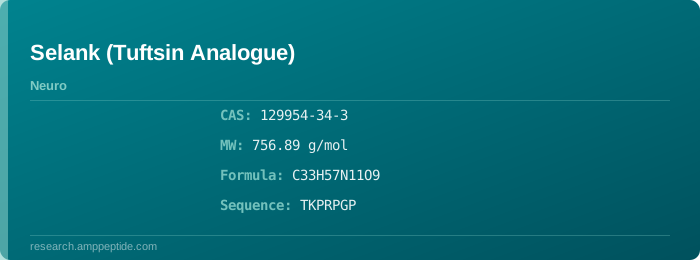
Selank is a synthetic heptapeptide analogue of the immunomodulatory tetrapeptide tuftsin (Thr-Lys-Pro-Arg), extended with the sequence Thr-Lys-Pro-Arg-Pro-Gly-Pro. It acts as a GABAergic modulator and enkephalinase inhibitor with pronounced anxiolytic, cognitive-enhancing, and immunomodulatory properties. In research settings, it is investigated for anxiety disorders, cognitive dysfunction, and immune dysregulation.
Chemical Profile
| Property |
Value |
| CAS Number |
129954-34-3 |
| IUPAC Name |
L-Threonyl-L-lysyl-L-prolyl-L-arginyl-L-prolylglycyl-L-proline |
| Amino Acid Sequence |
Thr-Lys-Pro-Arg-Pro-Gly-Pro (7 amino acids) |
| Sequence (1-Letter) |
TKPRPGP |
| Molecular Formula |
C₃₃H₅₇N₁₁O₉ |
| Molecular Weight |
756.89 g/mol |
| Purity (HPLC) |
≥ 98% |
Selank at a Glance
- Class: Synthetic tuftsin analogue
- Research Status: Preclinical and clinical (Russia, Ukraine)
- Route: Intranasal (primary), intravenous, intramuscular
- Half-life: ~20 minutes (intranasal)
- CAS: 129954-34-3
- MW: 756.9 Da
- Key Feature: Anxiolytic without sedation; cognitive enhancement
Mechanism of Action
Selank is a synthetic analogue of tuftsin (Thr-Lys-Pro-Arg), an endogenous immunomodulatory tetrapeptide derived from the Fc fragment of immunoglobulin G. The addition of Pro-Gly-Pro enhances metabolic stability and CNS activity.
Primary Signaling Pathways
| Component |
Detail |
| Primary Target |
GABAergic system (benzodiazepine-independent) |
| Enkephalinase Inhibition |
Neutral endopeptidase inhibitor → increased Met-enkephalin |
| Secondary Targets |
Serotonin (5-HT₁A, 5-HT₂), dopamine (D₂) receptors |
| GABAA Modulation |
Enhanced GABA binding affinity (allosteric modulation) |
| BDNF Modulation |
Moderate BDNF upregulation in hippocampus |
| Cytokine Modulation |
IL-1β, IL-6, TNF-α regulation (immune-thymic axis) |
| NO Synthase |
Reduced neuronal NO production |
Anxiolytic Mechanism
Unlike classical benzodiazepines, Selank does not act as a direct GABAA receptor agonist:
- GABAergic enhancement: Increases the affinity of GABA for its binding site on GABAA receptors (positive allosteric modulation) without binding to the benzodiazepine site
- Enkephalin system: Inhibits enkephalinase (neutral endopeptidase), elevating endogenous Met-enkephalin levels in the brain
- Serotonergic modulation: Normalizes 5-HT₁A and 5-HT₂ receptor binding density in stress conditions
- Dopaminergic modulation: Modulates D₂ receptor expression in the striatum
Immunomodulatory Effects
| System |
Effect |
Mechanism |
| Cytokine Balance |
Anti-inflammatory shift |
TNF-α and IL-6 reduction |
| Th1/Th2 |
Immunomodulatory |
Normalized ratio in stress |
| Phagocytosis |
Enhanced |
Macrophage activation |
| B-lymphocyte |
Modulated |
Antibody production |
Pharmacology
| Parameter |
Value |
| Half-life (t½) |
~20 minutes (intranasal); ~12 minutes (IV) |
| Bioavailability (IN) |
High (direct CNS delivery) |
| Tmax |
~5–10 minutes (intranasal) |
| Volume of Distribution (Vd) |
~0.4 L/kg |
| Protein Binding |
~25% |
| Metabolism |
Proteolytic cleavage (exopeptidase) |
| Route |
Intranasal, intravenous, intramuscular |
| Elimination |
Renal (peptide fragments) |
| BBB Permeability |
High via intranasal route |
Research Evidence
Dosing Reference
| Parameter |
Recommendation |
| Research Dose Range |
200–600 μg daily (intranasal) |
| Dosing Timing |
Morning and/or early afternoon |
| Duration |
1–3 months (cycle), with 2-week washout |
| Reconstitution |
1–2 mL bacteriostatic water |
| Storage (Lyophilized) |
−20°C, desiccated, light-protected |
| Storage (Reconstituted) |
2–8°C for up to 7 days |
Safety Profile
| Category |
Observations |
| Most Common |
Mild nasal irritation (intranasal) |
| CNS |
No sedation, no cognitive impairment at standard doses |
| Autonomic |
No cardiovascular effects at therapeutic doses |
| Dependence |
No benzodiazepine-like dependence observed |
| Contraindications |
Research use only; not approved outside Russia |
| Immunogenicity |
Very low (endogenous amino acid sequence) |
Physicochemical Properties
| Property |
Value |
| Physical State |
White to off-white lyophilized powder |
| Solubility (Water) |
Soluble (> 40 mg/mL) |
| Solubility (Saline) |
Soluble (> 20 mg/mL) |
| logP |
~ −3.0 (hydrophilic) |
| pI |
~9.8 (basic due to Arg and Lys residues) |
| Stability (Lyophilized) |
≥ 24 months at −20°C |
| Stability (Solution) |
7–10 days at 2–8°C |
Synthesis Pathway
Selank (Thr-Lys-Pro-Arg-Pro-Gly-Pro) is produced via standard solid-phase peptide synthesis (SPPS) using Fmoc chemistry, similar to other tuftsin-analogue peptides.
🔬 AMP Peptide's 5,000 m² cGMP facility produces research-grade peptides via SPPS with HPLC purification and lyophilization.
| Parameter |
Detail |
| Strategy |
Fmoc-SPPS on 2-chlorotrityl chloride resin (Pro-loaded) |
| Coupling Reagents |
HBTU/HOBt in NMP with DIPEA (4 eq. amino acid, 4 eq. HBTU, 8 eq. DIPEA) |
| Fmoc Deprotection |
20% piperidine in DMF (5 + 15 min) |
| Coupling Time |
30–60 min per residue (monitored by Kaiser test) |
| Cleavage Cocktail |
TFA/TIPS/H₂O (95:2.5:2.5, v/v/v) |
| Cleavage Time |
2 h at room temperature |
| Crude Purification |
Preparative RP-HPLC (C18, 0.1% TFA/MeCN, 10–30% B over 30 min) |
| Counterion Exchange |
Acetate form by lyophilization from 0.1 M AcOH |
| Overall Yield |
50–65% (crude); ≥ 98% after purification |
Note: The Arg(Pbf) side-chain protection requires extended TFA cleavage time (2–3 h) for complete deprotection. The C-terminal Pro-Gly-Pro motif confers enhanced resistance to carboxypeptidase-mediated degradation.
Analytical Methods
HPLC
🔬 AMP Peptide performs comprehensive quality control including HPLC, LC-MS, amino acid analysis, and endotoxin testing per pharmaceutical standards.
| Parameter |
Condition |
| Column |
C18 (4.6 × 250 mm, 5 μm) |
| Mobile Phase |
A: 0.1% TFA in water; B: 0.1% TFA in acetonitrile |
| Gradient |
5–35% B over 25 min |
| Flow Rate |
1.0 mL/min |
| Detection |
UV 214 nm |
| Retention Time |
~13–15 min |
LC-MS
| Parameter |
Condition |
| Ionization |
ESI+ |
| Detected (M+H)+ |
~757.9 Da |
| MS/MS Fragments |
b2–b6 and y2–y6 sequence ions |
Stability Data
| Condition |
Storage Parameters |
Stability |
| Lyophilized (−20°C) |
Desiccated, light-protected, argon atmosphere |
≥ 24 months |
| Lyophilized (4°C) |
Desiccated, light-protected |
≥ 12 months |
| Lyophilized (25°C) |
Ambient humidity control |
~2–4 months |
| Solution (2–8°C) |
Sterile saline or water, pH 4–5 |
7–10 days |
| Solution (25°C) |
Aqueous, pH 4–5 |
≤ 48 h |
| Solution (−20°C) |
Aqueous, single-use aliquots |
~1 month |
| Freeze-Thaw Stability |
3 cycles |
< 3% degradation per cycle |
| Oxidative Stability |
0.1% H₂O₂, 25°C, 1 h |
~15% oxidation (Met→MetO if present) |
Selank demonstrates good solution stability in mildly acidic conditions (pH 4–5). The Pro-Arg sequence is resistant to trypsin-like proteases, contributing to enhanced stability compared to the parent tuftsin (Thr-Lys-Pro-Arg). Lyophilized material should be equilibrated to room temperature before opening to prevent moisture condensation.
References
- Kozlovsky N, et al. (2008). Selank — clinical anxiolytic efficacy. Bulletin of Experimental Biology and Medicine. DOI: 10.1007/s10517-008-0083-x
- Narkevich VB, et al. (2006). Selank effects on serotonin receptors in stress. Bulletin of Experimental Biology and Medicine. DOI: 10.1007/s10517-006-0322-y
- Zolotarev YA, et al. (2003). Selank binding and enkephalinase inhibition. Biochemistry (Moscow). DOI: 10.1023/A:1021750328619
- Uchakina ON, et al. (2008). Selank immunomodulatory effects. Bulletin of Experimental Biology and Medicine. DOI: 10.1007/s10517-008-0119-2
- Bychkov ER, et al. (2004). Selank cognitive effects in rat hippocampus. Neuroscience and Behavioral Physiology. DOI: 10.1023/B:NERV.0000031115.50153.12
- Kolomin TA, et al. (2010). Pharmacokinetics of Selank. Eksperimentalnaya i Klinicheskaya Farmakologiya.
- Andreeva LA, et al. (2012). Tuftsin analogues: structure-activity relationships. Russian Journal of Bioorganic Chemistry.
🔗 AMP Peptide Product Link
Purchase Selank wholesale from AMP Peptide