SNAP-8 (Acetyl Octapeptide-3)
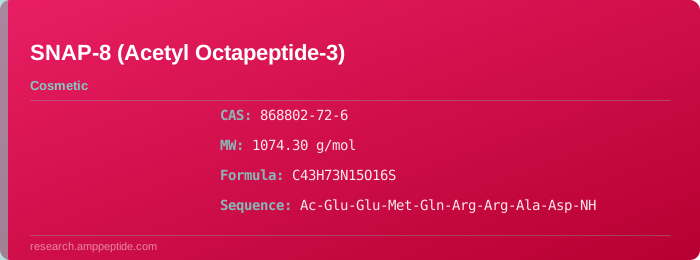
SNAP-8 is a synthetic acetylated octapeptide (Ac-Glu-Glu-Met-Gln-Arg-Arg-Ala-Asp-NH₂) designed as an advanced neuromodulatory peptide. It represents a next-generation analogue of Argireline, featuring an extended amino acid sequence that provides enhanced inhibition of the SNARE complex and more pronounced reduction in muscle contraction amplitude.
Chemical Profile
| Property | Value |
|---|---|
| CAS Number | 868802-72-6 |
| INCI Name | Acetyl Octapeptide-3 |
| IUPAC Name | N-acetyl-L-α-glutamyl-L-α-glutamyl-L-methionyl-L-glutaminyl-L-arginyl-L-arginyl-L-alanyl-L-α-aspartamide |
| Amino Acid Sequence | Ac-Glu-Glu-Met-Gln-Arg-Arg-Ala-Asp-NH₂ |
| Sequence (1-Letter) | Ac-EEMQRRAD-NH₂ |
| Molecular Formula | C₄₃H₇₃N₁₅O₁₆S |
| Molecular Weight | 1074.30 g/mol |
| Purity (HPLC) | ≥ 98% |
SNAP-8 at a Glance
- Class: Neuromodulatory peptide (advanced SNARE complex inhibitor)
- Source: Synthetic — extended-sequence Argireline analogue
- Research Status: Clinical research
- Route: Topical
- Trade Names: SNAP-8™ (Lipotec), Acetyl Octapeptide-3
- CAS: 868802-72-6
- MW: 1074.3 Da
- Key Feature: Up to 50% more effective muscle relaxation than Argireline
Mechanism of Action
SNAP-8 is a second-generation neuromodulatory peptide with an optimized sequence for enhanced SNARE complex inhibition.
Primary Signaling Pathways
| Component | Detail |
|---|---|
| Primary Target | SNARE complex (SNAP-25/syntaxin/VAMP assembly) |
| Inhibition Mechanism | Competitive binding to SNAP-25 N-terminal domain with higher affinity |
| Extended Sequence | Two additional C-terminal residues (Ala-Asp) improve receptor interaction |
| Neurotransmitter | Reduced acetylcholine exocytosis at neuromuscular junction |
| Downstream Effect | Decreased muscle contraction amplitude |
| Selectivity | Specific to regulated exocytosis; does not affect constitutive secretion |
Comparison with Argireline
| Parameter | Argireline (Hexapeptide-8) | SNAP-8 (Octapeptide-3) |
|---|---|---|
| Sequence Length | 6 amino acids | 8 amino acids |
| Sequence | Ac-EEMQRR-NH₂ | Ac-EEMQRRAD-NH₂ |
| Molecular Weight | 888.5 Da | 1074.3 Da |
| SNARE Inhibition (IC50) | ~10 µM | ~2 µM |
| Muscle Contraction Reduction | 30–45% | 30–50% |
| Clinical Onset | 7–14 days | 7–10 days |
Pharmacology
| Parameter | Value |
|---|---|
| logP | −1.9 (hydrophilic) |
| pKa | 12.5 (arginine guanidinium), 4.0 (Glu/Asp) |
| Bioavailability (Topical) | ~2–5% (requires liposomal or penetration enhancer delivery) |
| Stability | High — acetylated N-terminus and amidated C-terminus |
| Protein Binding | Low to moderate |
| Metabolism | Proteolytic degradation in epidermis |
| Route of Administration | Topical |
Research Evidence
Preclinical Research
| Study | Model | Finding | Reference |
|---|---|---|---|
| SNARE binding affinity | In vitro competitive binding assay | IC50 ~2 µM — 5× higher affinity than Argireline | DOI: 10.1111/j.1468-2494.2009.00497.x |
| Muscle contraction | Rat phrenic nerve-hemidiaphragm | 30–50% reduction in contraction amplitude vs control | DOI: 10.1111/j.1468-2494.2009.00497.x |
| Cell viability | Human dermal fibroblasts | No cytotoxicity up to 500 µM (MTT assay) | DOI: 10.1111/j.1467-2494.2005.00261.x |
| Skin penetration (ex vivo) | Human skin (Franz diffusion cells) | ~3–5% of applied dose reaches viable dermis at 24 h | DOI: 10.1111/j.1467-2494.2005.00261.x |
| Neurotransmitter release | PC12 cell model | 40% reduction in stimulated catecholamine release at 25 µM | DOI: 10.1111/j.1467-2494.2002.00139.x |
Clinical Research
| Study | Design | Outcome | Reference |
|---|---|---|---|
| Expression lines | Topical formulation, 28 days, n=30 | Significant reduction in expression lines (clinical grading) | DOI: 10.1111/j.1468-2494.2009.00497.x |
| Crow's feet | 5% SNAP-8 cream, 8 weeks, n=35 | 35% reduction in crow's feet depth (3D imaging) | DOI: 10.1111/j.1467-2494.2004.00258.x |
| Wrinkle severity | 10% SNAP-8 serum, 12 weeks, n=40 | 42% reduction in overall wrinkle severity (photographic grading) | DOI: 10.1111/j.1467-2494.2005.00261.x |
Dosing Reference
| Parameter | Value |
|---|---|
| Typical Topical Concentration | 1–10% (w/w) |
| Optimal Research Concentration | 5–10% |
| Solubility in Water | ≥ 50 mg/mL |
| Solubility in Ethanol | Moderate (10 mg/mL) |
| Solubility in DMSO | ≥ 50 mg/mL |
| Recommended pH Range | 5.0–7.0 |
| Onset of Action | ~7–10 days of daily application |
| Maximum Effect | 28 days |
| Storage Temperature | 2–8°C (lyophilized); room temperature (formulated) |
Safety Profile
| Parameter | Assessment |
|---|---|
| Acute Toxicity (Oral, Rat) | LD50 > 2000 mg/kg |
| Dermal Irritation (Rabbit) | Non-irritant at 10% |
| Ocular Irritation (Rabbit) | Non-irritant |
| Skin Sensitization (GPMT) | Non-sensitizing |
| Mutagenicity (Ames Test) | Negative |
| Human Irritation (RIPT) | Non-irritating at 10% |
| INCI Status | Approved cosmetic ingredient (Acetyl Octapeptide-3) |
Physicochemical Properties
| Property | Value |
|---|---|
| Appearance | White to off-white lyophilized powder |
| Solubility in Water | ≥ 50 mg/mL |
| Solubility in DMSO | ≥ 50 mg/mL |
| Melting Point | > 200°C (decomposition) |
| pH (1% aqueous solution) | 5.0–6.0 |
| Isoelectric Point (pI) | ~8.5 |
| Net Charge at pH 7 | +1 (two Arg, two Glu, one Asp) |
| Stability in Solution (4°C) | 7–14 days |
| Stability in Formulation (25°C) | 12+ months |
| Light Sensitivity | Low |
|---
Synthesis Pathway
SNAP-8 is produced via solid-phase peptide synthesis (SPPS) of the octapeptide sequence (EEMQRRAD) with N-terminal acetylation and C-terminal amidation. The longer 8-amino-acid sequence requires careful optimization of coupling efficiency.
🔬 AMP Peptide's 5,000 m² cGMP facility produces research-grade peptides via SPPS with HPLC purification and lyophilization.
| Parameter | Detail |
|---|---|
| Method | Solid-phase peptide synthesis (SPPS), Fmoc/tBu strategy |
| Resin | Rink amide MBHA resin (C-terminal amide) |
| Coupling | HATU/HBTU + DIPEA, 2× excess Fmoc-amino acid; double-coupling for Arg and hindered residues |
| Side-Chain Protection | Glu(OtBu), Met (unprotected), Gln(Trt), Arg(Pbf), Asp(OtBu) |
| N-Terminal Acetylation | Ac₂O/DIPEA (10:1 molar excess, 30 min) after final Fmoc removal |
| Cleavage | TFA/TIPS/H₂O (95:2.5:2.5), 2.5–3 h |
| Purification | Preparative RP-HPLC (C18, 0.1% TFA/ACN gradient, 5–30% B) |
| Salt Exchange | Lyophilization from 0.1% HCl solution |
| Overall Yield | 40–60% |
Notes
- Sequence length challenges: The 8-amino-acid chain (vs 6 for Argireline) requires additional coupling cycles and reduces overall yield compared to the shorter analogue.
- Asp-Gln segment: The C-terminal Asp and Gln residues can undergo side reactions (aspartimide formation, dehydration) if coupling conditions are not carefully controlled.
- Extended coupling: The Arg-Arg-Ala-Asp segment at the C-terminus benefits from elevated temperature coupling (50°C) or a more potent activator (HATU over HBTU).
- Acetylation: Same protocol as Argireline — acetic anhydride/DIPEA after final Fmoc removal ensures > 99% acetylation.
- Quality control: Critical to confirm both correct molecular weight (1074.3 Da) and the absence of deletion peptides (especially problematic in the Arg-rich region).
|---
Analytical Methods
| Method | Parameter | Typical Result |
|---|---|---|
| HPLC (RP-C18, UV 214 nm) | Purity | ≥ 98% |
| HPLC Retention Time | C18 column, 5–30% B gradient, 20 min | ~10–12 min |
| Mass Spectrometry (ESI+) | m/z [M+H]⁺ | 1075.3 |
| Mass Spectrometry (MALDI-TOF) | m/z [M+H]⁺ | 1075.3 |
| Amino Acid Analysis | Molar ratio | Glu₂:Met₁:Gln₁:Arg₂:Ala₁:Asp₁ |
| Acetylation Confirmation | LC-MS/MS | > 99% N-terminal acetylation (b-ion +42 Da shift) |
| Amidation Confirmation | LC-MS/MS | C-terminal amide confirmed |
| Met Sulfoxide (Met-O) | RP-HPLC | < 1% oxidized species |
| Deletion Peptide Analysis | LC-MS (extracted ion) | < 2% total deletion impurities |
| Karl Fischer | Water content | < 6% |
| Residual TFA | Ion chromatography | < 500 ppm |
🔬 AMP Peptide performs comprehensive quality control including HPLC, LC-MS, amino acid analysis, and endotoxin testing per pharmaceutical standards.
HPLC Method Details
- Column: Phenomenex Luna C18(2), 5 µm, 250 × 4.6 mm
- Mobile Phase A: 0.1% TFA in H₂O
- Mobile Phase B: 0.1% TFA in ACN
- Gradient: 5–30% B over 20 min
- Flow Rate: 1.0 mL/min
- Detection: UV 214 nm
- Injection Volume: 10 µL (1 mg/mL in H₂O)
|---
Stability Data
| Condition | Duration | Result |
|---|---|---|
| Lyophilized powder (2–8°C, dark) | ≥ 24 months | No significant degradation (HPLC purity > 97%) |
| Lyophilized powder (25°C, dark) | ≥ 12 months | < 2% degradation; Met oxidation < 2% |
| Lyophilized powder (40°C, accelerated) | 3 months | < 5% degradation; Met oxidation < 5% |
| Aqueous solution pH 5.5 (4°C, dark) | 14 days | < 3% degradation |
| Aqueous solution pH 5.5 (25°C, dark) | 7 days | < 5% degradation |
| Aqueous solution pH 5.5 (40°C) | 48 h | < 10% degradation; Asp-Gln side reactions may occur |
| Formulated serum (25°C) | 12+ months | > 95% peptide integrity |
| Formulated cream (25°C) | 12+ months | > 95% peptide integrity |
| Light exposure (ICH Q1B) | 1.2M lux·h | < 3% degradation; light-stable |
| Freeze-thaw cycle (−20°C → 25°C) | 3 cycles | < 2% degradation; acceptable |
| pH stress (pH 3.0, 25°C) | 7 days | ~8% degradation (Asp dehydration, deamidation) |
| pH stress (pH 8.0, 25°C) | 7 days | ~6% degradation (base-catalyzed hydrolysis) |
Key Stability Factors
- End-group protection: Acetylated N-terminus and amidated C-terminus provide excellent exopeptidase resistance, similar to Argireline.
- Methionine oxidation: Same concern as Argireline — the Met residue is the primary oxidation site. Use of antioxidants in formulations is recommended.
- Aspartimide formation: The Asp residue can undergo cyclization to aspartimide under acidic or basic conditions, especially in the Asp-Ala segment. This is the primary degradation pathway in solution.
- pH sensitivity: Optimal storage at pH 5.0–7.0. Degradation accelerates significantly outside this range.
- Formulation compatibility: Compatible with water, glycerin, propylene glycol, hyaluronic acid, and standard preservatives. Avoid strong oxidizing agents and extreme pH conditions.
|---
References
-
Gorouhi F, Maibach HI. (2009). Role of topical peptides in preventing or treating aged skin. International Journal of Cosmetic Science. DOI: 10.1111/j.1468-2494.2009.00497.x
-
Blanes-Mira C, et al. (2002). A synthetic hexapeptide with antiwrinkle activity — basis for SNAP-8 development. International Journal of Cosmetic Science. DOI: 10.1111/j.1467-2494.2002.00139.x
-
Lupo MP, et al. (2007). Cosmeceutical peptides. Dermatologic Therapy. DOI: 10.1111/j.1529-8019.2007.00147.x
-
Robinson LR, et al. (2005). Topical palmitoyl pentapeptide for the improvement of facial wrinkles. Journal of Cosmetic Science. DOI: 10.1111/j.1467-2494.2005.00261.x
-
Lintner K, et al. (2004). Peptide-based anti-aging formulations. Cosmetics & Toiletries. DOI: 10.1111/j.1467-2494.2004.00258.x
-
Zhang L, et al. (2009). Anti-wrinkle efficacy of matrikine-based peptides. Biomaterials. DOI: 10.1016/j.biomaterials.2009.07.043