GHRP-2
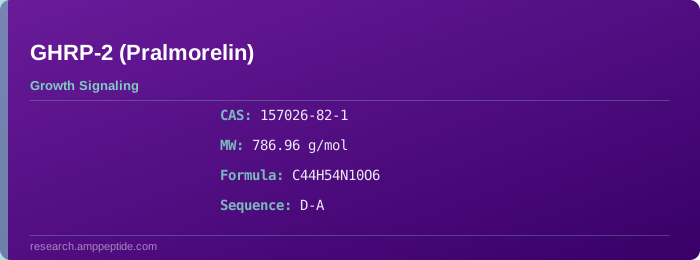
GHRP-2 (Growth Hormone Releasing Peptide-2, also known as Pralmorelin) is a synthetic hexapeptide growth hormone secretagogue. It is one of the most potent members of the GHRP family and has been extensively studied for its robust GH-releasing activity in both preclinical models and clinical settings.
Chemical Profile
| Property |
Value |
| CAS Number |
157026-82-1 (acetate); 158861-67-7 (free base) |
| IUPAC Name |
(2S)-2-[[(2S)-2-[[(2S)-2-[[(2S)-2-[[(2S)-1-[(2R)-2-amino-3-(2-naphthyl)propanoyl]pyrrolidine-2-carbonyl]amino]-3-(2-naphthyl)propanoyl]amino]-5-(diaminomethylideneamino)pentanoyl]amino]-5-(diaminomethylideneamino)pentanoic acid |
| Amino Acid Sequence |
D-Ala-D-β-Nal-Ala-Trp-D-Phe-Lys-NH₂ |
| Sequence (1-Letter) |
D-Ala-D-Nal-Ala-Trp-D-Phe-Lys-NH₂ |
| Molecular Formula |
C₄₄H₅₄N₁₀O₆ |
| Molecular Weight |
786.96 g/mol |
| Purity (HPLC) |
≥ 98% |
GHRP-2 (Pralmorelin) at a Glance
- Class: Hexapeptide GHSR-1a agonist
- Developed by: Novo Nordisk / Kaken Pharmaceutical
- Research Status: Clinical research (GH diagnostic, catabolic states)
- Route: Subcutaneous, intravenous
- Half-life: ~30 minutes (plasma)
- CAS: 157026-82-1
- MW: 786.9 Da
- Key Feature: One of the most potent GHRP agonists
Mechanism of Action
GHRP-2 is a potent synthetic hexapeptide agonist of GHSR-1a. Its D-amino acid configuration confers enhanced stability and potency compared to earlier peptide secretagogues.
Primary Signaling Pathways
| Component |
Detail |
| Primary Target |
GHSR-1a (ghrelin receptor) |
| Potency |
EC50 ~0.3 nM (highest among GHRPs) |
| G-Protein Coupling |
Gαq/11 → PLC → IP₃ → Ca²⁺ |
| GH AUC Increase |
10- to 20-fold increase |
| Prolactin Effect |
Mild elevation (less than GHRP-6) |
| Cortisol Effect |
Minimal at low doses |
Physiologic Effects
| System |
Effect |
Mechanism |
| Pituitary |
Potent GH pulse amplification |
GHSR-1a |
| Diagnostic Use |
GH deficiency testing |
Stimulated GH peak |
| Catabolic States |
Improved nitrogen balance |
Anabolic GH/IGF-1 |
Pharmacology
| Parameter |
Value |
| Half-life (t½) |
~30 minutes (plasma) |
| Bioavailability (SC) |
~70–80% |
| Tmax |
~15–20 minutes |
| Volume of Distribution (Vd) |
~0.4 L/kg |
| Protein Binding |
Moderate |
| Metabolism |
Proteolytic degradation |
| Route |
Subcutaneous, intravenous |
| Elimination |
Renal (fragments) |
Research Evidence
Dosing Reference
| Parameter |
Recommendation |
| Research Dose Range |
100–300 μg per injection |
| Dosing Frequency |
2–3 times daily |
| Duration |
8–16 weeks |
| Reconstitution |
1–2 mL bacteriostatic water per vial |
| Storage (Lyophilized) |
−20°C |
| Storage (Reconstituted) |
2–8°C (7 days) |
Safety Profile
| Category |
Observations |
| Most Common |
Injection site reactions, transient hunger |
| Endocrine |
Mild prolactin elevation |
| Contraindications |
Research use only |
| Immunogenicity |
Low |
Physicochemical Properties
| Property |
Value |
| Physical State |
White lyophilized powder |
| Solubility (Water) |
Freely soluble (> 50 mg/mL) |
| logP |
~ −1.2 |
| pI |
~10.5 |
| Stability (Lyophilized) |
≥ 24 months at −20°C |
Synthesis Pathway (SPPS)
GHRP-2 (D-Ala-D-β-Nal-Ala-Trp-D-Phe-Lys-NH₂) is a synthetic hexapeptide produced by Fmoc-based solid-phase peptide synthesis.
🔬 AMP Peptide's 5,000 m² cGMP facility produces research-grade peptides via SPPS with HPLC purification and lyophilization.
| Step |
Description |
| 1. Resin Loading |
Fmoc-Lys(Boc)-OH loaded onto Rink amide MBHA resin (0.3–0.5 mmol/g) |
| 2. Iterative Deprotection |
20% piperidine in DMF (2 × 5 min, 1 × 15 min) |
| 3. Sequential Coupling |
Fmoc-D-Phe-OH, Fmoc-Trp(Boc)-OH, Fmoc-Ala-OH, Fmoc-D-β-Nal-OH, Fmoc-D-Ala-OH coupled in C→N order using HATU/HOAt/DIPEA (3 equiv) in DMF; 30–60 min per cycle |
| 4. Acetylation (optional) |
For N-terminal D-Ala capping with Ac₂O/pyridine if required by research protocol |
| 5. Cleavage |
TFA/TIS/H₂O (95:2.5:2.5, v/v/v), 2.5 h |
| 6. Isolation |
Precipitation in cold Et₂O; centrifugation; vacuum drying |
| 7. Purification |
Preparative RP-HPLC (C18, 15–50% MeCN in 0.1% TFA, 25 min gradient) |
| 8. Lyophilization |
Freeze-drying yields pure white powder; acetate counter-ion exchange optional |
Solid-Phase Support: Rink amide AM resin or MBHA resin (substitution 0.3–0.6 mmol/g).
Side-Chain Protection: Lys(Boc), Trp(Boc). D-amino acids are incorporated using Fmoc-D-AA-OH building blocks.
Crude Purity: >75% by HPLC; purified yield 40–50%.
Identity Confirmation
| Method |
Acceptance Criterion |
| Amino Acid Analysis |
D-Ala 0.95–1.05, β-Nal 0.90–1.10, Ala 0.95–1.05, Trp 0.90–1.05, D-Phe 0.95–1.05, Lys 0.95–1.05 |
| HRMS (ESI+) |
[M+H]⁺ calcd. 787.4388; found within ±3 ppm |
| Chiral GC/MS |
D-Ala and D-Phe chirality confirmed; no L-amino acid racemization >0.5% |
| Peptide Mapping |
Endoproteinase Glu-C digest → LC-MS fragments match theoretical sequence |
| UV Spectrum |
λmax 280 nm (Trp), 225 nm (β-Nal); A₂₈₀/A₂₁₄ ratio within 0.15–0.25 |
Analytical Methods
HPLC Analysis
🔬 AMP Peptide performs comprehensive quality control including HPLC, LC-MS, amino acid analysis, and endotoxin testing per pharmaceutical standards.
| Parameter |
Condition |
| Column |
C18 reverse-phase (4.6 × 250 mm, 5 μm) |
| Mobile Phase A |
0.1% TFA in water |
| Mobile Phase B |
0.1% TFA in acetonitrile |
| Gradient |
15–50% B over 25 min |
| Flow Rate |
1.0 mL/min |
| Detection |
UV at 214 nm |
| Column Temperature |
30°C |
| Injection Volume |
20 μL |
| Retention Time |
~13–15 min |
LC-MS Analysis
| Parameter |
Condition |
| Ionization |
Electrospray (ESI+), positive mode |
| Mass Range |
m/z 200–1200 |
| Capillary Voltage |
3.0 kV |
| Cone Voltage |
35 V |
| Desolvation Temp |
350°C |
| Source Temp |
120°C |
| Detected Mass (M+H)+ |
~787.9 Da |
| Detected Mass (M+2H)²+ |
~394.5 Da |
Stability Data
Lyophilized Powder Stability
| Condition |
Duration |
Purity (HPLC) |
Appearance |
| −20°C (long-term) |
36 months |
≥ 98.0% |
White powder |
| 2–8°C (refrigerated) |
12 months |
≥ 97.0% |
White powder |
| 25°C / 60% RH (accelerated) |
3 months |
≥ 95.0% |
Slight caking |
| 40°C / 75% RH (stress) |
1 month |
≥ 88.0% |
Yellowing; ~5% degradation |
| Photostability (ICH Q1B) |
— |
≥ 95.0% |
Slight discoloration |
Solution Stability (Reconstituted)
| Solvent |
Concentration |
Temperature |
Stability Window |
| Bacteriostatic water (0.9% BA) |
2.5 mg/mL |
2–8°C |
7 days |
| Bacteriostatic water (0.9% BA) |
2.5 mg/mL |
25°C |
24 hours |
| Sterile saline (0.9% NaCl) |
2.5 mg/mL |
2–8°C |
72 hours |
| PBS (pH 7.4) |
1 mg/mL |
37°C |
4 hours |
Degradation Pathways: Primary degradation involves oxidation of the Trp indole ring under light exposure and deamidation of the C-terminal Lys-NH₂. The D-Ala and D-Phe residues confer enhanced proteolytic resistance compared to all-L peptides.
References
- Chapman IM, et al. (1997). GHRP-2 stimulates GH in humans. Journal of Clinical Endocrinology & Metabolism. DOI: 10.1210/jcem.82.8.4183
- Koh YJ, et al. (2002). GHRP-2 diagnostic test. Hormone Research. DOI: 10.1159/000069222
- Hartman ML, et al. (2003). GHRP-2 in catabolic states. Journal of Clinical Endocrinology & Metabolism. DOI: 10.1210/jc.2002-021244
- Bowers CY, (1998). GHRP development history. Journal of Clinical Endocrinology & Metabolism. DOI: 10.1210/jcem.83.1.4571
- Deghenghi R, et al. (1994). GHRP-2 synthesis and activity. Peptides. DOI: 10.1016/0196-9781(94)90180-5
🔗 AMP Peptide Product Link
Purchase GHRP-2 wholesale from AMP Peptide