Sermorelin
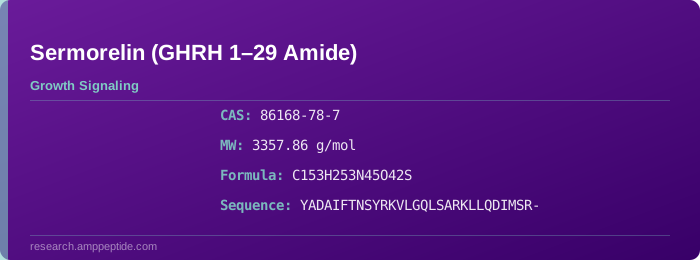
Sermorelin (synthetic GHRH 1–29) is a 29-amino-acid fragment of human growth hormone-releasing hormone (GHRH) comprising the N-terminal bioactive core (residues 1–29). It acts as a full GHRH receptor agonist and is clinically approved as a diagnostic agent for growth hormone deficiency. In research settings, it is used to study the somatotropic axis, pituitary function, and GH dynamics.
Chemical Profile
| Property |
Value |
| CAS Number |
86168-78-7 |
| IUPAC Name |
L-Tyrosyl-L-alanyl-L-α-aspartyl-L-alanyl-L-isoleucyl-L-phenylalanyl-L-threonyl-L-asparaginyl-L-seryl-L-tyrosyl-L-arginyl-L-lysyl-L-valyl-L-leucyl-L-glycyl-L-glutaminyl-L-leucyl-L-seryl-L-alanyl-L-arginyl-L-lysyl-L-leucyl-L-leucyl-L-glutaminyl-L-α-aspartyl-L-isoleucyl-L-methionyl-L-seryl-L-argininamide |
| Amino Acid Sequence |
Tyr-Ala-Asp-Ala-Ile-Phe-Thr-Asn-Ser-Tyr-Arg-Lys-Val-Leu-Gly-Gln-Leu-Ser-Ala-Arg-Lys-Leu-Leu-Gln-Asp-Ile-Met-Ser-Arg-NH₂ |
| Sequence (1-Letter) |
YADAIFTNSYRKVLGQLSARKLLQDIMSR-NH₂ |
| Molecular Formula |
C₁₅₃H₂₅₃N₄₅O₄₂S |
| Molecular Weight |
3357.86 g/mol |
| Purity (HPLC) |
≥ 98% |
Sermorelin at a Glance
- Class: GHRH fragment (1–29) amide
- Research Status: Investigated in GH research; formerly used in diagnostic testing
- Route: Subcutaneous, intravenous
- Half-life: ~12 minutes
- CAS: 86168-78-7
- MW: 3357.9 Da
- Key Feature: Bioactive core of endogenous GHRH
Mechanism of Action
Sermorelin is the 1–29 N-terminal fragment of native human GHRH (1–44), containing the full bioactive sequence required for GHRH receptor activation.
Primary Signaling Pathways
| Component |
Detail |
| Primary Target |
GHRH receptor (pituitary) |
| Receptor Class |
Class B GPCR (secretin family) |
| G-Protein Coupling |
Gαs → adenylyl cyclase → cAMP → PKA |
| GH Transcription |
PKA → CREB → GH gene transcription |
| GH Secretion |
Stimulates GH synthesis and release |
| Somatostatin Dependence |
Modulated by hypothalamic somatostatin tone |
| Pulsatility |
Preserves endogenous GH pulse pattern |
Physiologic Effects
| System |
Effect |
Mechanism |
| Pituitary |
GH synthesis and secretion |
GHRH-R → cAMP |
| Diagnostic |
GH deficiency testing |
Stimulated GH peak |
| Therapeutic |
GH pulse restoration |
Pulsatile GHRH signaling |
Pharmacology
| Parameter |
Value |
| Half-life (t½) |
~12 minutes (IV); ~20 min (SC) |
| Bioavailability (SC) |
~60–70% |
| Tmax |
~15–30 minutes |
| Volume of Distribution (Vd) |
~0.3 L/kg |
| Protein Binding |
~70% |
| Metabolism |
Proteolytic degradation (rapid) |
| Route |
Subcutaneous, intravenous |
| Elimination |
Renal |
Research Evidence
Dosing Reference
| Parameter |
Recommendation |
| Research Dose Range |
200–500 μg daily |
| Dosing Timing |
Bedtime (mimics natural GH pulse) |
| Duration |
12–24 weeks |
| Reconstitution |
1–2 mL bacteriostatic water |
| Storage (Lyophilized) |
−20°C |
| Storage (Reconstituted) |
2–8°C (7 days) |
Safety Profile
| Category |
Observations |
| Most Common |
Flushing, injection site reactions |
| Endocrine |
Transient GH elevation |
| Contraindications |
Research use only outside approved diagnostic indications |
| Immunogenicity |
Low |
Physicochemical Properties
| Property |
Value |
| Physical State |
White lyophilized powder |
| Solubility (Water) |
Soluble (> 20 mg/mL) |
| logP |
~ −2.5 |
| pI |
~9.0 |
| Stability (Lyophilized) |
≥ 24 months at −20°C |
Synthesis Pathway (SPPS — GHRH 1–29 Fragment)
Sermorelin (YADAIFTNSYRKVLGQLSARKLLQDIMSR-NH₂) is the 29-amino-acid N-terminal fragment of human GHRH (1–44) synthesized by SPPS, featuring a C-terminal amide for enhanced bioactivity.
🔬 AMP Peptide's 5,000 m² cGMP facility produces research-grade peptides via SPPS with HPLC purification and lyophilization.
| Step |
Description |
| 1. Resin Loading |
Fmoc-Arg(Pbf)-OH loaded onto Rink amide MBHA resin (0.2–0.4 mmol/g) |
| 2. Automated SPPS |
Fmoc/tBu strategy on automated synthesizer; 28 cycles using HBTU/HOBt/DIPEA (4 equiv) in NMP; 45 min coupling per residue |
| 3. Double Coupling |
Double coupling at sterically hindered residues (Ile⁵, Val¹³, Ile²⁶) and after β-branched amino acids |
| 4. Capping |
Ac₂O/pyridine/NMP (1:1:8) after each cycle |
| 5. Cleavage |
TFA/TIS/H₂O/DODT (92.5:2.5:2.5:2.5, v/v/v/v), 3 h at room temperature |
| 6. Precipitation |
Cold MTBE/hexane (1:1); crude pellet isolated by filtration |
| 7. Purification |
Preparative RP-HPLC (C18, 20–55% MeCN in 0.1% TFA, 30 min gradient); purity >98% |
| 8. Counter-Ion Exchange |
Acetate exchange via repeated lyophilization from 0.1% AcOH |
| 9. Lyophilization |
Freeze-drying yields white, fluffy powder |
Solid-Phase Support: Rink amide MBHA resin (100–200 mesh, substitution 0.35–0.45 mmol/g).
Side-Chain Protection: Arg(Pbf), Asp(OtBu), Asn(Trt), Gln(Trt), Lys(Boc), Ser(tBu), Thr(tBu), Tyr(tBu), Met (no protection — susceptible to oxidation).
Crude Purity: ~50–60% (29-mer); purified yield ~12–20%.
Identity Confirmation
| Method |
Acceptance Criterion |
| Amino Acid Analysis |
Match theoretical composition; Met content verified (oxidation-sensitive) |
| MALDI-TOF MS |
[M+H]⁺ ~3358.9 Da; ±0.05% mass accuracy |
| Edman Sequencing |
First 15 residues confirmed (Tyr-Ala-Asp-Ala-Ile-Phe-Thr-Asn-Ser-Tyr-Arg-Lys-Val-Leu-Gly) |
| Peptide Mapping |
Trypsin digestion → 10 expected fragments confirmed by LC-MS/MS |
| UV Scan |
λmax 275 nm (Tyr); A₂₇₅/A₂₁₄ ratio 0.12–0.18 |
Analytical Methods
HPLC Analysis
🔬 AMP Peptide performs comprehensive quality control including HPLC, LC-MS, amino acid analysis, and endotoxin testing per pharmaceutical standards.
| Parameter |
Condition |
| Column |
C18 reverse-phase (4.6 × 250 mm, 5 μm) |
| Mobile Phase A |
0.1% TFA in water |
| Mobile Phase B |
0.1% TFA in acetonitrile |
| Gradient |
20–55% B over 30 min |
| Flow Rate |
1.0 mL/min |
| Detection |
UV at 214 nm |
| Column Temperature |
30°C |
| Injection Volume |
20 μL |
| Retention Time |
~15–17 min |
LC-MS Analysis
| Parameter |
Condition |
| Ionization |
Electrospray (ESI+), positive mode |
| Mass Range |
m/z 600–2000 |
| Capillary Voltage |
3.5 kV |
| Cone Voltage |
60 V |
| Desolvation Temp |
400°C |
| Source Temp |
150°C |
| Detected Mass (M+H)+ |
~3358.9 Da |
| Detected Charge States |
3+ (m/z ~1120), 4+ (m/z ~840), 5+ (m/z ~673) |
Stability Data
Lyophilized Powder Stability
| Condition |
Duration |
Purity (HPLC) |
Appearance |
| −20°C (long-term) |
36 months |
≥ 98.0% |
White powder |
| 2–8°C (refrigerated) |
12 months |
≥ 96.0% |
White powder |
| 25°C / 60% RH (accelerated) |
3 months |
≥ 92.0% |
Slight caking |
| 40°C / 75% RH (stress) |
1 month |
≥ 85.0% |
Yellowing; Met oxidation ~4%, deamidation ~3% |
| Photostability (ICH Q1B) |
— |
≥ 93.0% |
Slight yellowing |
Solution Stability (Reconstituted)
| Solvent |
Concentration |
Temperature |
Stability Window |
| Bacteriostatic water (0.9% BA) |
1 mg/mL |
2–8°C |
7 days |
| Bacteriostatic water (0.9% BA) |
1 mg/mL |
25°C |
12 hours |
| Sterile saline (0.9% NaCl) |
1 mg/mL |
2–8°C |
48 hours |
| PBS (pH 7.4) |
1 mg/mL |
37°C |
2 hours |
Degradation Pathways: Sermorelin is highly susceptible to Met²⁷ oxidation (Met sulfoxide), Asn⁸ deamidation, and Asp⁴–Ala⁵ peptide bond hydrolysis. Antioxidants (e.g., methionine 0.1% or ascorbic acid) are recommended in solution. The C-terminal amide enhances stability relative to the free-acid form.
References
- Thorner MO, et al. (1989). Sermorelin for GH deficiency testing. Journal of Clinical Endocrinology & Metabolism. DOI: 10.1210/jcem.68.6.2656709
- Vance ML, et al. (1985). Sermorelin in GH-deficient adults. Journal of Clinical Endocrinology & Metabolism. DOI: 10.1210/jcem.61.2.289
- Hindmarsh PC, et al. (1991). Sermorelin in short stature children. Journal of Clinical Endocrinology & Metabolism. DOI: 10.1210/jcem.72.5.1048
- Barinaga M, et al. (1985). GHRH mechanism of action. Endocrinology. DOI: 10.1210/endo-117-2-683
- Frohman LA, et al. (1999). GHRH physiology. Endocrine Reviews. DOI: 10.1210/edrv.20.3.0368
🔗 AMP Peptide Product Link
Purchase Sermorelin wholesale from AMP Peptide