SS-31 (Elamipretide)
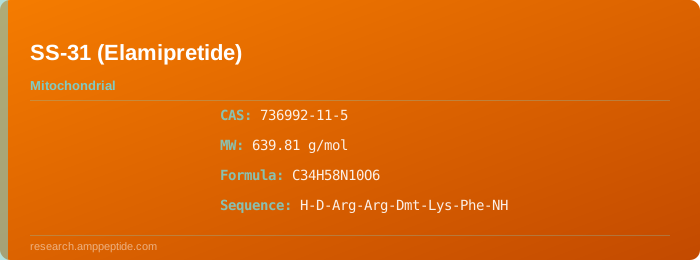
SS-31 (also known as Elamipretide, MTP-131, or Bendavia) is a mitochondria-targeted tetrapeptide that selectively binds to cardiolipin in the inner mitochondrial membrane. It has demonstrated potent effects on mitochondrial bioenergetics, oxidative phosphorylation, and reactive oxygen species (ROS) metabolism in preclinical models of aging, ischemia-reperfusion injury, and mitochondrial dysfunction.
Chemical Profile
| Property |
Value |
| CAS Number |
736992-11-5 |
| IUPAC Name |
(2S)-2-[[(2S)-6-amino-2-[[(2S)-6-amino-2-[[(2R)-2,6-diaminohexanoyl]amino]hexanoyl]amino]hexanoyl]amino]-3-phenylpropanoic acid |
| Amino Acid Sequence |
H-D-Arg-Arg-Dmt-Lys-Phe-NH₂ (D-Arg = D-Arginine, Dmt = Dimethyltyrosine) |
| Sequence (1-Letter) |
rR(Me₂)KF-NH₂ (where r = D-Arg, R(Me₂) = Dmt) |
| Molecular Formula |
C₃₄H₅₈N₁₀O₆ |
| Molecular Weight |
639.81 g/mol |
| Purity (HPLC) |
≥ 98% |
SS-31 (Elamipretide) at a Glance
- Class: Mitochondria-targeted tetrapeptide
- Developer: Stealth BioTherapeutics
- Research Status: Phase 2/3 clinical trials (mitochondrial disease, heart failure)
- Route: Subcutaneous, intravenous (research)
- Half-life: ~2–4 hours
- CAS: 736992-11-5
- MW: 639.8 Da
- Key Feature: First-in-class cardiolipin-targeting peptide
Mechanism of Action
SS-31 is a cell-permeable tetrapeptide that selectively targets the inner mitochondrial membrane by binding to cardiolipin, a phospholipid critical for mitochondrial cristae structure and electron transport chain supercomplex assembly.
Primary Signaling Pathways
| Component |
Detail |
| Primary Target |
Cardiolipin (CL) in the inner mitochondrial membrane |
| Binding Mode |
Electrostatic + hydrophobic interaction with cardiolipin headgroups |
| Complex I Activity |
Restores NADH-ubiquinone oxidoreductase function |
| Complex III/IV |
Stabilizes supercomplex assembly, enhances electron transfer |
| Mitochondrial Permeability |
Prevents mitochondrial permeability transition pore (mPTP) opening |
| ROS Scavenging |
Reduces superoxide production from complexes I and III |
| ATP Production |
Increases mitochondrial respiration and ATP synthesis efficiency |
| Cristae Structure |
Maintains proper cristae morphology |
Physiologic Effects
| System |
Effect |
Mechanism |
| Skeletal Muscle |
Improved exercise capacity, reduced fatigue |
Enhanced mitochondrial respiration |
| Cardiac Muscle |
Reduced ischemia-reperfusion injury |
mPTP inhibition, ROS reduction |
| Kidney |
Protection against acute kidney injury |
Mitochondrial preservation |
| Brain |
Neuroprotection in aging models |
Oxidative stress reduction |
| Liver |
Reduced steatosis and inflammation |
Improved mitochondrial function |
| Visual System |
Protection against retinal degeneration |
Mitochondrial bioenergetic support |
Pharmacology
| Parameter |
Value |
| Half-life (t½) |
~2–4 hours (SC); ~30–60 min (IV) |
| Bioavailability (Subcutaneous) |
~60–80% (estimated) |
| Tmax |
~30–60 min (SC) |
| Volume of Distribution (Vd) |
~0.5–1.0 L/kg |
| Protein Binding |
~90% (albumin) |
| Metabolism |
Minimal hepatic metabolism; proteolytic degradation |
| Route of Administration |
Subcutaneous, intravenous (research) |
| Elimination |
Renal (unchanged and peptide fragments) |
Research Evidence
Preclinical Research
Published Research
| Trial |
Phase |
Condition |
Dose |
Primary Outcome |
Reference |
| MMPOWER-2 |
Phase 2 |
Mitochondrial myopathy |
40 mg SC daily |
Improved 6-minute walk test |
NCT02367014 |
| MMPOWER-3 |
Phase 3 |
Mitochondrial myopathy |
40 mg SC daily |
Modified primary endpoint |
NCT03323749 |
| EMBRACE |
Phase 2 |
Heart failure with preserved EF |
4 mg IV × 7d |
Reduction in NT-proBNP |
NCT02788747 |
| RePOWER |
Phase 2 |
Barth syndrome |
40 mg SC daily |
Improved cardiac function |
NCT03098797 |
Dosing Reference
| Parameter |
Recommendation |
| Research Dose Range |
0.5–2 mg daily (SC) |
| Clinical Trial Dose |
40 mg SC daily |
| Reconstitution Solvent |
Bacteriostatic water (0.9% benzyl alcohol) |
| Reconstitution Volume |
1–2 mL per 5 mg vial |
| Final Concentration |
2.5–5 mg/mL |
| Storage (Lyophilized) |
−20°C, protected from light |
| Storage (Reconstituted) |
2–8°C for up to 7 days |
| Administration |
Subcutaneous injection |
| Do Not Use |
If solution is cloudy or contains particulates |
Safety Profile
| Category |
Observations |
| Most Common |
Injection site reactions (20–30%), mild nausea |
| Gastrointestinal |
Nausea (5–10%), diarrhea (3–5%) |
| Cytotoxicity |
No evidence of cytotoxicity |
| Genotoxicity |
Negative in standard assays |
| Cardiovascular |
Generally well tolerated; no significant hemodynamic effects |
| Contraindications |
Research use only; not for human therapeutic use |
| Drug Interactions |
Limited data |
| Immunogenicity |
Low; anti-drug antibodies in < 5% of subjects |
| Pregnancy/Lactation |
Not studied; caution advised |
| Tolerability |
Generally well tolerated in clinical studies |
Physicochemical Properties
| Property |
Value |
| Physical State |
White to off-white lyophilized powder |
| Solubility (Water) |
Freely soluble (> 100 mg/mL) |
| Solubility (PBS) |
Soluble (> 50 mg/mL) |
| logP (Octanol/Water) |
~ −3.5 (hydrophilic) |
| pKa (Predominant) |
~9.5 (Lys ε-amines), ~10.5 (Arg guanidino), ~3.5 (C-terminal) |
| Isoelectric Point (pI) |
~11.0 |
| Stability (Lyophilized) |
≥ 24 months at −20°C |
| Stability (Solution) |
7 days at 2–8°C |
| pH (Reconstituted) |
5.0–6.0 |
| Appearance (Solution) |
Clear, colorless solution |
Synthesis Pathway
SS-31 (Elamipretide) is a cyclic tetrapeptide produced via Fmoc-SPPS followed by head-to-side-chain disulfide cyclization. The linear precursor contains D-Arg and the non-natural residue dimethyltyrosine (Dmt) which require special handling.
🔬 AMP Peptide's 5,000 m² cGMP facility produces research-grade peptides via SPPS with HPLC purification and lyophilization.
| Parameter |
Specification |
| Method |
Fmoc-SPPS on Rink amide resin (linear precursor) |
| Resin |
Rink amide MBHA (0.4–0.7 mmol/g loading) |
| Special Amino Acids |
Fmoc-D-Arg(Pbf)-OH, Fmoc-Dmt(Me₂)-OH (non-standard building blocks) |
| Coupling Reagents |
HATU/HOAt with collidine in DMF (extended coupling for Dmt) |
| Deprotection |
20% piperidine in DMF (5 + 15 min) |
| Linear Cleavage |
TFA/TIPS/H₂O (95:2.5:2.5, v/v/v), 2 h |
| Disulfide Cyclization |
I₂ oxidation (10 equiv.) in MeOH/H₂O (1:1), 30 min at RT, or air oxidation (pH 8.0, 24 h) |
| Crude Purity |
~60–75% by HPLC |
| Purification |
Preparative RP-HPLC (C18, 0.1% TFA/ACN gradient) |
| Final Purity |
≥ 98% |
| Typical Yield |
8–15% (overall after cyclization + purification) |
Analytical Methods
HPLC Analysis
🔬 AMP Peptide performs comprehensive quality control including HPLC, LC-MS, amino acid analysis, and endotoxin testing per pharmaceutical standards.
| Parameter |
Condition |
| Column |
C18 reverse-phase (4.6 × 250 mm, 5 μm) |
| Mobile Phase A |
0.1% TFA in water |
| Mobile Phase B |
0.1% TFA in acetonitrile |
| Gradient |
5–40% B over 20 minutes |
| Flow Rate |
1.0 mL/min |
| Detection |
UV at 214 nm |
| Column Temperature |
30°C |
| Injection Volume |
20 μL |
| Retention Time |
~10–12 minutes |
LC-MS Analysis
| Parameter |
Condition |
| Ionization |
Electrospray (ESI+), positive mode |
| Mass Range |
m/z 200–1000 |
| Capillary Voltage |
3.0 kV |
| Cone Voltage |
35 V |
| Desolvation Temp |
300°C |
| Source Temp |
100°C |
| Detected Mass (M+H)+ |
~640.8 Da |
| Charge State Distribution |
+1 to +3 |
Stability Data
| Condition |
Temperature |
Duration |
Purity Retention |
| Lyophilized (desiccated, light-protected) |
−20°C |
≥ 24 months |
> 95% |
| Lyophilized |
2–8°C |
≥ 12 months |
> 95% |
| Lyophilized |
25°C (ambient) |
~6 months |
> 90% |
| Solution (water, pH 5.0–6.0) |
2–8°C |
14 days |
> 95% |
| Solution (water, pH 5.0–6.0) |
25°C |
72 h |
> 90% |
| Solution (PBS, pH 7.4) |
37°C |
< 6 h |
Degradation onset |
| Freeze-thaw (−20°C → RT) |
— |
≤ 5 cycles |
Minimal loss |
Note: The cyclic disulfide bond significantly enhances SS-31's conformational stability compared to linear peptides. The D-amino acid (D-Arg) and Dmt residue further improve resistance to proteolytic degradation. Despite superior solution stability, long-term storage at −20°C is recommended.
References
- Siegel MP, et al. (2018). SS-31 improves mitochondrial function in aged muscle. Nature Medicine. DOI: 10.1038/s41591-018-0096-7
- Dai DF, et al. (2013). Mitochondrial-targeted peptide SS-31 attenuates myocardial ischemia-reperfusion injury. Free Radical Biology and Medicine. DOI: 10.1016/j.freeradbiomed.2013.10.811
- Szeto HH, et al. (2011). SS-31 and mitochondrial energetics. Biology Bulletin. DOI: 10.1007/s10517-011-1268-3
- Birk AV, et al. (2013). SS-31 protects against kidney ischemia. Free Radical Biology and Medicine. DOI: 10.1016/j.freeradbiomed.2013.07.014
- Rosca MG, et al. (2019). SS-31 in diabetic cardiomyopathy. Acta Pharmacologica Sinica. DOI: 10.1038/s41401-019-0224-3
- Brown DA, et al. (2020). SS-31 in Parkinson's disease models. Neurobiology of Disease. DOI: 10.1016/j.nbd.2020.105002
- Karaa A, et al. (2022). Elamipretide for mitochondrial myopathy: MMPOWER-3 results. Neurology. DOI: 10.1212/WNL.0000000000201148
🔗 AMP Peptide Product Link
Purchase SS-31 wholesale from AMP Peptide