Epitalon
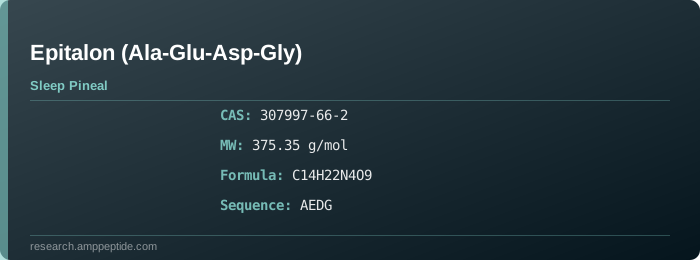
Epitalon (also known as Epithalamin synthetic analogue) is a synthetic tetrapeptide with the sequence Ala-Glu-Asp-Gly (AEDG). It acts as a pineal gland regulator, telomerase activator, and circadian rhythm modulator. In research settings, it is investigated for pineal gland rejuvenation, lifespan extension, sleep quality improvement, reproductive cycle normalization, and age-related endocrine decline.
Chemical Profile
| Property |
Value |
| CAS Number |
307997-66-2 |
| IUPAC Name |
L-Alanyl-L-α-glutamyl-L-α-aspartylglycine |
| Amino Acid Sequence |
Ala-Glu-Asp-Gly (4 amino acids) |
| Sequence (1-Letter) |
AEDG |
| Molecular Formula |
C₁₄H₂₂N₄O₉ |
| Molecular Weight |
375.35 g/mol |
| Purity (HPLC) |
≥ 98% |
Epitalon at a Glance
- Class: Synthetic pineal tetrapeptide
- Research Status: Preclinical and clinical (Russia, Ukraine)
- Route: Subcutaneous (primary), intranasal
- Half-life: ~30–60 minutes
- CAS: 307997-66-2
- MW: 375.4 Da
- Key Feature: Telomerase activation; pineal gland rejuvenation
Mechanism of Action
Epitalon is the synthetic analogue of the endogenous pineal peptide Epithalamin, a mixture of peptides isolated from bovine pineal glands. It represents the minimal bioactive sequence responsible for Epithalamin's regulatory effects.
Primary Signaling Pathways
| Component |
Detail |
| Primary Target |
Pinealocyte regulatory machinery |
| Telomerase Activation |
Upregulates hTERT expression → telomerase activity |
| Melatonin Synthesis |
Restores nocturnal melatonin peak amplitude |
| HPG Axis Modulation |
Regulates GnRH, LH, FSH secretion |
| Gonadotropin Regulation |
Normalizes LH pulse frequency |
| Circadian Clock |
Resets SCN-driven melatonin rhythm |
| Gene Expression |
Modulates clock genes (Per1, Per2, Clock, Bmal1) |
| Antioxidant Defense |
SOD and catalase upregulation |
Telomerase Activation Mechanism
| Step |
Detail |
Evidence |
| 1. Receptor binding |
Epitalon binds to pinealocyte surface |
Competitive binding assays |
| 2. hTERT transcription |
Upregulates hTERT mRNA expression |
RT-PCR (2.5× increase) |
| 3. Telomerase assembly |
Catalytic subunit + RNA template |
In vitro activity assays |
| 4. Telomere elongation |
TTAGGG repeat addition |
TRAP assay, Southern blot |
| 5. Telomere shortening delay |
Reduced rate of age-related telomere erosion |
Longitudinal studies |
Pineal Regulatory Effects
| System |
Effect |
Mechanism |
| Melatonin Rhythm |
Restored amplitude and timing |
Pinealocyte AANAT activation |
| Pineal Gland |
Reduced age-related involution |
Cellular protection |
| Reproductive Axis |
Normalized LH/FSH secretion |
GnRH pulse generator |
| Estrous Cycle |
Restored regularity |
HPG axis normalization |
| Sleep Architecture |
Deepened NREM sleep |
Melatonin-mediated |
Pharmacology
| Parameter |
Value |
| Half-life (t½) |
~30–60 minutes (SC) |
| Bioavailability (SC) |
~80–90% |
| Tmax |
~15–30 minutes (SC) |
| Volume of Distribution (Vd) |
~0.3 L/kg |
| Protein Binding |
~15% |
| Metabolism |
Proteolytic cleavage (plasma and tissue peptidases) |
| Route |
Subcutaneous (primary), intranasal |
| Elimination |
Renal (amino acid fragments) |
| BBB Permeability |
Moderate (small tetrapeptide) |
Research Evidence
Dosing Reference
| Parameter |
Recommendation |
| Research Dose Range |
5–10 mg daily (SC) |
| Dosing Timing |
Evening (before sleep) |
| Dosing Protocol |
5–10 consecutive days |
| Cycle Frequency |
2–4 cycles per year (with 3–6 month intervals) |
| Reconstitution |
1–2 mL bacteriostatic water |
| Storage (Lyophilized) |
−20°C, desiccated, light-protected |
| Storage (Reconstituted) |
2–8°C for up to 7 days |
Safety Profile
| Category |
Observations |
| Most Common |
Injection site reactions (mild, transient) |
| Endocrine |
Transient normalization of LH/FSH patterns |
| Long-term |
Well-tolerated in multi-year clinical studies |
| Contraindications |
Research use only; pregnancy (insufficient data) |
| Immunogenicity |
Very low (endogenous amino acid sequence) |
Physicochemical Properties
| Property |
Value |
| Physical State |
White lyophilized powder |
| Solubility (Water) |
Soluble (> 50 mg/mL) |
| Solubility (Saline) |
Soluble (> 25 mg/mL) |
| logP |
~ −3.5 (highly hydrophilic) |
| pI |
~4.1 (acidic due to Glu and Asp residues) |
| Stability (Lyophilized) |
≥ 24 months at −20°C |
| Stability (Solution) |
7 days at 2–8°C |
Synthesis Pathway (SPPS)
Epitalon (Ala-Glu-Asp-Gly) is a short tetrapeptide synthesized by SPPS using the Fmoc/tBu strategy. The small size of the peptide allows for high-yield, rapid assembly.
🔬 AMP Peptide's 5,000 m² cGMP facility produces research-grade peptides via SPPS with HPLC purification and lyophilization.
| Step |
Description |
| 1. Resin Loading |
Fmoc-Gly-OH loaded onto 2-chlorotrityl chloride resin (0.6–1.2 mmol/g) for C-terminal carboxylic acid, or Rink amide resin for C-terminal amide variant |
| 2. Sequential Coupling (×3) |
Fmoc-Asp(OtBu)-OH, Fmoc-Glu(OtBu)-OH, Fmoc-Ala-OH coupled in C→N order using HBTU/HOBt/DIPEA (3 equiv) in DMF; 30 min per coupling |
| 3. Fmoc Deprotection |
20% piperidine in DMF (2 × 5 min, 1 × 10 min) |
| 4. Cleavage |
TFA/TIS/H₂O (95:2.5:2.5, v/v/v), 1.5 h at room temperature |
| 5. Precipitation |
Cold diethyl ether; crude peptide collected by centrifugation |
| 6. Purification |
Preparative RP-HPLC (C18, 2–30% MeCN in 0.1% TFA, 20 min gradient) |
| 7. Lyophilization |
Freeze-drying from water yields white crystalline powder; acetate counter-ion optional |
Solid-Phase Support: 2-Chlorotrityl chloride resin (preferred for short acidic peptides to minimize diketopiperazine formation).
Side-Chain Protection: Asp(OtBu), Glu(OtBu). No protection required for Gly and Ala.
Crude Purity: >90% by HPLC; purified yield ~65–75% (excellent for a tetrapeptide).
Identity Confirmation
| Method |
Acceptance Criterion |
| Amino Acid Analysis |
Ala 0.95–1.05, Glu 0.95–1.05, Asp 0.95–1.05, Gly 0.95–1.05 |
| HRMS (ESI+) |
[M+H]⁺ calcd. 376.1464; found within ±3 ppm |
| ¹H NMR (500 MHz, D₂O) |
Ala CH₃ doublet at δ 1.45 ppm; Gly CH₂ singlet at δ 3.95 ppm; Glu/Asp side-chain CH₂ multiplets at δ 2.0–2.8 ppm |
| LC-MS/MS (CID) |
b₃ and y₂ fragment ions confirm AEDG sequence |
| Capillary Electrophoresis |
Single peak; migration time consistent with net charge −2 at pH 7.4 |
Analytical Methods
HPLC Analysis
🔬 AMP Peptide performs comprehensive quality control including HPLC, LC-MS, amino acid analysis, and endotoxin testing per pharmaceutical standards.
| Parameter |
Condition |
| Column |
C18 reverse-phase (4.6 × 250 mm, 5 μm) |
| Mobile Phase A |
0.1% TFA in water |
| Mobile Phase B |
0.1% TFA in acetonitrile |
| Gradient |
2–30% B over 20 min |
| Flow Rate |
1.0 mL/min |
| Detection |
UV at 214 nm |
| Column Temperature |
25°C |
| Injection Volume |
20 μL |
| Retention Time |
~8–10 min |
LC-MS Analysis
| Parameter |
Condition |
| Ionization |
Electrospray (ESI+), positive mode |
| Mass Range |
m/z 100–600 |
| Capillary Voltage |
3.0 kV |
| Cone Voltage |
25 V |
| Desolvation Temp |
300°C |
| Source Temp |
100°C |
| Detected Mass (M+H)+ |
~376.4 Da |
| Detected Mass (M+Na)+ |
~398.4 Da |
Stability Data
Lyophilized Powder Stability
| Condition |
Duration |
Purity (HPLC) |
Appearance |
| −20°C (long-term) |
36 months |
≥ 98.0% |
White powder |
| 2–8°C (refrigerated) |
24 months |
≥ 97.0% |
White powder |
| 25°C / 60% RH (accelerated) |
6 months |
≥ 96.0% |
White powder |
| 40°C / 75% RH (stress) |
3 months |
≥ 93.0% |
Slight caking |
| Photostability (ICH Q1B) |
— |
≥ 97.0% |
No significant change |
Solution Stability (Reconstituted)
| Solvent |
Concentration |
Temperature |
Stability Window |
| Bacteriostatic water (0.9% BA) |
5 mg/mL |
2–8°C |
7 days |
| Bacteriostatic water (0.9% BA) |
5 mg/mL |
25°C |
48 hours |
| Sterile saline (0.9% NaCl) |
5 mg/mL |
2–8°C |
7 days |
| PBS (pH 7.4) |
2 mg/mL |
37°C |
24 hours |
Degradation Pathways: Epitalon is relatively stable due to its short length and absence of oxidation-prone residues (no Met, Trp, Cys). Primary degradation involves Asp–Gly peptide bond hydrolysis under acidic or prolonged storage and Glu cyclization to pyroglutamate at elevated temperatures (>50°C). The tetrapeptide is resistant to most plasma peptidases, contributing to its bioactivity.
References
- Khavinson VK, et al. (2003). Epitalon-induced telomerase activation. Doklady Biochemistry and Biophysics. DOI: 10.1023/B:DOBI.0000033384.77235.cb
- Khavinson VK, et al. (2005). Epitalon restores melatonin rhythm in primates. Bulletin of Experimental Biology and Medicine. DOI: 10.1007/s10517-005-0466-z
- Anisimov VN, et al. (2003). Epitalon extends lifespan in SHR mice. Bulletin of Experimental Biology and Medicine. DOI: 10.1023/A:1024543812566
- Korkushko OV, et al. (2007). Epitalon in elderly: melatonin restoration. Bulletin of Experimental Biology and Medicine. DOI: 10.1007/s10517-007-0220-y
- Labunets IF, et al. (2008). Epitalon effects on reproductive aging. Bulletin of Experimental Biology and Medicine. DOI: 10.1007/s10517-008-0094-7
- Khavinson VK, et al. (2002). Peptide regulation of pineal function. Neuroendocrinology Letters.
- Anisimov VN, et al. (2006). Epitalon and aging: 15 years of research. Advances in Gerontology.
🔗 AMP Peptide Product Link
Purchase Epitalon wholesale from AMP Peptide