CJC-1295
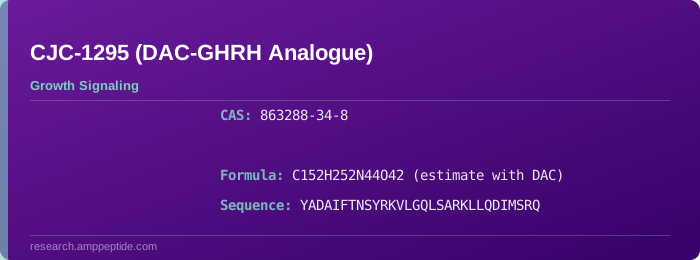
CJC-1295 is a synthetic 30-amino-acid analogue of human growth hormone-releasing hormone (GHRH) modified with Drug Affinity Complex (DAC) technology. The covalent attachment of a reactive maleimide group enables selective and sustained binding to circulating albumin, extending its half-life and providing prolonged GHRH receptor activation for continuous GH and IGF-1 release.
Chemical Profile
| Property |
Value |
| CAS Number |
863288-34-8 |
| IUPAC Name |
L-Tyrosyl-L-alanyl-L-α-aspartyl-L-alanyl-L-isoleucyl-L-phenylalanyl-L-threonyl-L-asparaginyl-L-seryl-L-tyrosyl-L-arginyl-L-lysyl-L-valyl-L-leucyl-L-α-glutaminyl-L-glutaminyl-L-leucyl-L-seryl-L-alanyl-L-arginyl-L-lysyl-L-leucyl-L-leucyl-L-α-glutaminyl-L-α-aspartyl-L-isoleucyl-L-methionyl-L-seryl-L-arginyl-L-glutamine (with terminal DAC modification) |
| Amino Acid Sequence |
Tyr-Ala-Asp-Ala-Ile-Phe-Thr-Asn-Ser-Tyr-Arg-Lys-Val-Leu-Gln-Gln-Leu-Ser-Ala-Arg-Lys-Leu-Leu-Gln-Asp-Ile-Met-Ser-Arg-Gln-OH (C-terminal DAC modification) |
| Sequence (1-Letter) |
YADAIFTNSYRKVLGQLSARKLLQDIMSRQ (with DAC) |
| Molecular Formula |
C₁₅₂H₂₅₂N₄₄O₄₂ (estimate with DAC) |
| Molecular Weight |
~3315.7 g/mol (with DAC modification) |
| Purity (HPLC) |
≥ 98% |
CJC-1295 at a Glance
- Class: GHRH analogue with DAC technology
- Developed By: ConjuChem Biotechnologies
- Research Status: Phase 1/2 clinical trials
- Route: Subcutaneous
- Half-life: ~6–8 days (albumin-bound)
- CAS: 863288-34-8
- MW: ~3315.7 Da (with DAC)
- Key Feature: Sustained GH/IGF-1 elevation for 6+ days
Mechanism of Action
CJC-1295 combines a potent GHRH analogue with a reactive maleimide group that covalently binds to cysteine-34 of circulating albumin, creating a long-acting depot.
Primary Signaling Pathways
| Component |
Detail |
| Primary Target |
GHRH receptor (pituitary somatotrophs) |
| Receptor Class |
Class B GPCR |
| G-Protein Coupling |
Gαs → adenylyl cyclase → cAMP → PKA |
| Albumin Binding |
Covalent (maleimide-Cys34); half-life ~6–8 days |
| GH Release |
Sustained pulse amplification |
| IGF-1 Elevation |
~2- to 3-fold increase sustained for 6+ days |
Physiologic Effects
| System |
Effect |
Mechanism |
| Pituitary |
Sustained GH secretion |
GHRH-R agonism |
| Hepatic |
IGF-1 production |
GH pulse-driven |
| Muscle |
Protein synthesis |
IGF-1 anabolic effect |
| Bone |
Bone turnover markers |
GH/IGF-1 |
| Metabolism |
Lipolysis |
GH-mediated |
Pharmacology
| Parameter |
Value |
| Half-life (t½) |
~6–8 days (albumin-conjugated) |
| Bioavailability (SC) |
~70–80% |
| Tmax (GH) |
~12–24 hours |
| IGF-1 Peak |
~48–72 hours |
| Protein Binding |
> 99% (albumin conjugate) |
| Metabolism |
Proteolytic degradation |
| Route |
Subcutaneous |
| Elimination |
Renal |
Research Evidence
Dosing Reference
| Parameter |
Recommendation |
| Research Dose Range |
1–2 mg per injection |
| Dosing Frequency |
Every 5–8 days |
| Duration |
8–16 weeks |
| Reconstitution |
1–2 mL bacteriostatic water |
| Storage (Lyophilized) |
−20°C |
| Storage (Reconstituted) |
2–8°C (7 days) |
Safety Profile
| Category |
Observations |
| Most Common |
Injection site reactions, transient flushing |
| Endocrine |
Sustained GH/IGF-1 elevation |
| Contraindications |
Research use only |
| Immunogenicity |
Low–moderate (anti-GHRH antibodies in some subjects) |
Physicochemical Properties
| Property |
Value |
| Physical State |
White lyophilized powder |
| Solubility (Water) |
Soluble (> 20 mg/mL) |
| logP |
~ −2.0 |
| pI |
~8.5 |
| Stability (Lyophilized) |
≥ 24 months at −20°C |
Synthesis Pathway (SPPS with DAC Conjugation)
CJC-1295 is a 30-amino-acid GHRH analogue produced by SPPS, followed by post-synthetic conjugation of a Drug Affinity Complex (DAC™) maleimide moiety for covalent albumin binding.
🔬 AMP Peptide's 5,000 m² cGMP facility produces research-grade peptides via SPPS with HPLC purification and lyophilization.
| Step |
Description |
| 1. Resin Loading |
Fmoc-Gln(Trt)-OH loaded onto Wang resin or HMPB-ChemMatrix (0.2–0.4 mmol/g) for C-terminal carboxylic acid |
| 2. SPPS Assembly |
Fmoc/tBu strategy; 29 coupling cycles using HATU/HOAt/DIPEA in NMP; double coupling at sterically hindered or β-branched residues (Ile, Val, Thr) |
| 3. Side-Chain Protection |
Arg(Pbf), Asp(OtBu), Asn(Trt), Gln(Trt), Lys(Boc), Ser(tBu), Thr(tBu), Tyr(tBu) |
| 4. Pseudoproline Dipeptide |
Use of Fmoc-Ser(ψMe,Mepro)-OH at Ser⁷–Tyr⁸ to improve coupling efficiency in the mid-sequence region |
| 5. Cleavage |
TFA/TIS/H₂O/DODT (92.5:2.5:2.5:2.5, v/v/v/v), 3 h |
| 6. DAC Conjugation |
Purified GHRH analogue dissolved in pH 6.5 phosphate buffer; maleimide-PEG₄-MPA-NHS ester (DAC reagent) added at 1.2 equiv; reaction monitored by LC-MS until >95% conversion (typically 2–4 h at 25°C) |
| 7. Purification |
Preparative RP-HPLC (C18, 20–60% MeCN in 0.1% TFA, 30 min gradient); albumin-binding fractions confirmed by SDS-PAGE shift |
| 8. Lyophilization |
Freeze-drying yields white amorphous powder; stored under argon |
Solid-Phase Support: HMPB-ChemMatrix resin (high-swelling for long peptides).
DAC Reagent: Maleimide-PEG₄-MPA (maleimidopropionic acid-PEG₄) targeting Cys34 of human serum albumin.
Crude Purity: ~55–65% (30-mer); purified yield ~15–25% after DAC conjugation and two HPLC passes.
Identity Confirmation
| Method |
Acceptance Criterion |
| Amino Acid Analysis |
All 30 residues within ±10% of theoretical |
| MALDI-TOF MS |
[M+H]⁺ ~3316.7 Da (DAC-conjugated); ±0.05% mass accuracy |
| ES-TOF MS |
Deconvoluted mass matches theoretical mass of DAC-conjugated peptide |
| SDS-PAGE |
Shift from ~3.3 kDa (unconjugated) to ~69 kDa (albumin-bound complex) |
| SEC-HPLC |
Monomeric peak at retention time consistent with albumin adduct |
| Tryptic Mapping |
LC-MS/MS sequence coverage >95% for the 30-amino-acid backbone |
Analytical Methods
HPLC Analysis
🔬 AMP Peptide performs comprehensive quality control including HPLC, LC-MS, amino acid analysis, and endotoxin testing per pharmaceutical standards.
| Parameter |
Condition |
| Column |
C18 reverse-phase (4.6 × 250 mm, 5 μm) |
| Mobile Phase A |
0.1% TFA in water |
| Mobile Phase B |
0.1% TFA in acetonitrile |
| Gradient |
20–60% B over 30 min |
| Flow Rate |
1.0 mL/min |
| Detection |
UV at 214 nm |
| Column Temperature |
30°C |
| Injection Volume |
20 μL |
| Retention Time |
~16–18 min (DAC-conjugated) |
LC-MS Analysis
| Parameter |
Condition |
| Ionization |
Electrospray (ESI+), positive mode |
| Mass Range |
m/z 600–2000 (wide range for 3.3 kDa peptide) |
| Capillary Voltage |
3.5 kV |
| Cone Voltage |
60 V |
| Desolvation Temp |
400°C |
| Source Temp |
150°C |
| Detected Mass (M+H)+ |
~3316.7 Da |
| Detected Charge States |
3+ (m/z ~1106), 4+ (m/z ~830), 5+ (m/z ~664) |
Stability Data
Lyophilized Powder Stability
| Condition |
Duration |
Purity (HPLC) |
Appearance |
| −20°C (long-term) |
36 months |
≥ 98.0% |
White powder |
| 2–8°C (refrigerated) |
12 months |
≥ 96.0% |
White powder |
| 25°C / 60% RH (accelerated) |
3 months |
≥ 93.0% |
Slight caking |
| 40°C / 75% RH (stress) |
1 month |
≥ 88.0% |
Yellowing; maleimide hydrolysis |
| Photostability (ICH Q1B) |
— |
≥ 94.0% |
No significant change |
Solution Stability (Reconstituted)
| Solvent |
Concentration |
Temperature |
Stability Window |
| Bacteriostatic water (0.9% BA) |
2 mg/mL |
2–8°C |
7 days |
| Bacteriostatic water (0.9% BA) |
2 mg/mL |
25°C |
12 hours |
| PBS (pH 7.4) |
1 mg/mL |
2–8°C |
48 hours |
| PBS (pH 7.4) |
1 mg/mL |
37°C |
4 hours |
Degradation Pathways: The maleimide DAC moiety is susceptible to ring-opening hydrolysis at pH > 7.5, reducing albumin-binding capacity. The GHRH peptide backbone undergoes deamidation at Asn⁸ and Gln¹⁵ under thermal stress. Lyophilized product stored at −20°C with desiccant is recommended for extended stability.
References
- Teichman SL, et al. (2006). CJC-1295: Sustained GH release in humans. Journal of Clinical Endocrinology & Metabolism. DOI: 10.1210/jc.2004-2195
- Ionescu M, et al. (2007). CJC-1295 in GH deficiency. Journal of Clinical Endocrinology & Metabolism. DOI: 10.1210/jc.2006-2431
- Alba M, et al. (2006). CJC-1295 pharmacology in rats. Endocrinology. DOI: 10.1210/en.2005-1623
- Pombo M, et al. (2004). GHRH analogue development. Frontiers in Neuroendocrinology. DOI: 10.1016/j.yfrne.2004.05.001
- Jaffe CA, et al. (1999). GHRH and GH pharmacology. Endocrine Reviews. DOI: 10.1210/edrv.20.3.0367
🔗 AMP Peptide Product Link
Purchase CJC-1295 wholesale from AMP Peptide