Matrixyl 3000
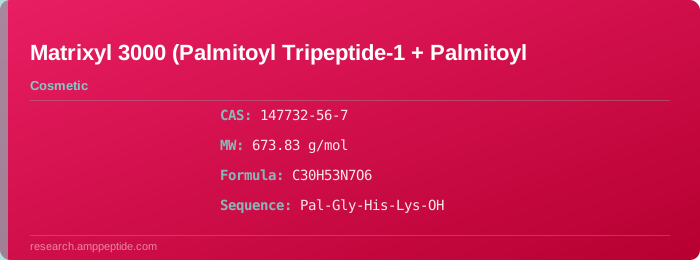
Matrixyl 3000 is a proprietary synergistic blend of two palmitoylated signal peptides: Palmitoyl Tripeptide-1 (Pal-Gly-His-Lys-OH) and Palmitoyl Tetrapeptide-7 (Pal-Gly-Gln-Pro-Arg-OH). This dual-peptide complex targets both collagen synthesis and anti-inflammatory pathways, providing comprehensive dermal matrix support.
Chemical Profile
Component 1: Palmitoyl Tripeptide-1
| Property | Value |
|---|---|
| CAS Number | 147732-56-7 |
| INCI Name | Palmitoyl Tripeptide-1 |
| Amino Acid Sequence | Pal-Gly-His-Lys-OH |
| Molecular Formula | C₃₀H₅₃N₇O₆ |
| Molecular Weight | 673.83 g/mol |
Component 2: Palmitoyl Tetrapeptide-7
| Property | Value |
|---|---|
| CAS Number | 221227-05-0 |
| INCI Name | Palmitoyl Tetrapeptide-7 |
| Amino Acid Sequence | Pal-Gly-Gln-Pro-Arg-OH |
| Molecular Formula | C₃₀H₅₂N₈O₇ |
| Molecular Weight | 520.68 g/mol |
Overall Blend
| Property | Value |
|---|---|
| Trade Name | Matrixyl™ 3000 (Sederma) |
| Blend Ratio | 6:4 (Tripeptide-1 : Tetrapeptide-7, typical commercial) |
| Combined MW | ~1194.51 g/mol (combined) |
| Purity (HPLC) | ≥ 95% (combined) |
Matrixyl 3000 at a Glance
- Class: Dual palmitoylated matrikine signal peptides
- Source: Synthetic — collagen-derived matrikine + immunoglobulin-derived peptide
- Research Status: Extensive clinical research
- Route: Topical
- Trade Names: Matrixyl™ 3000 (Sederma/Ashland)
- Research Focus: Synergistic — collagen stimulation + anti-inflammatory pathways
- Components: Palmitoyl Tripeptide-1 (collagen synthesis) + Palmitoyl Tetrapeptide-7 (anti-inflammatory)
Mechanism of Action
Matrixyl 3000 combines two complementary mechanisms: matrikine signaling for collagen production and anti-inflammatory modulation for extracellular matrix protection.
Component 1: Palmitoyl Tripeptide-1 — Collagen Synthesis
| Component | Detail |
|---|---|
| Primary Target | Fibroblast TGF-β receptor signaling |
| Mechanism | Matrikine mimic — stimulates procollagen synthesis |
| Collagen Types | Upregulation of collagen I, III, and IV |
| ECM Components | Increased fibronectin, elastin, and laminin |
| Copper Role | GHK sequence binds trace copper for enzymatic activity |
Component 2: Palmitoyl Tetrapeptide-7 — Anti-Inflammatory
| Component | Detail |
|---|---|
| Primary Target | IL-6 and IL-1β signaling pathways |
| Mechanism | Downregulation of pro-inflammatory cytokine production |
| Anti-Inflammatory | Reduces IL-6 output from stimulated fibroblasts |
| Origin Mimic | Derived from immunoglobulin G heavy chain fragment |
| Protective Effect | Prevents cytokine-induced collagen degradation |
Synergistic Effects
| Parameter | Individual Peptides | Matrixyl 3000 Blend |
|---|---|---|
| Collagen I Stimulation | 70–100% increase | 180–200% increase |
| IL-6 Reduction | Minimal (Tripeptide-1) | 50–70% reduction |
| Skin Firmness (Clinical) | 12–18% improvement | 25–30% improvement |
| Wrinkle Reduction | 25–35% | 45–70% |
Pharmacology
| Parameter | Tripeptide-1 | Tetrapeptide-7 |
|---|---|---|
| logP | 4.0 (lipophilic) | 3.8 (lipophilic) |
| Bioavailability (Topical) | ~5–10% | ~5–10% |
| Stability | High (palmitoyl protection) | High (palmitoyl protection) |
| Metabolism | Proteolytic degradation | Proteolytic degradation |
| Route of Administration | Topical | Topical |
Research Evidence
Preclinical Research
| Study | Model | Finding | Reference |
|---|---|---|---|
| Collagen synthesis (blend) | Human dermal fibroblasts | 2.8× increase in collagen I mRNA vs untreated control | DOI: 10.1016/j.biomaterials.2009.07.043 |
| IL-6 suppression | LPS-stimulated fibroblasts | 65% reduction in IL-6 secretion at 25 µg/mL | DOI: 10.1016/j.biomaterials.2009.07.043 |
| ECM gene expression | Aged human fibroblasts | Upregulation of 38 ECM-related genes; downregulation of 6 MMP genes | DOI: 10.1111/j.1467-2494.2004.00258.x |
| Ex vivo penetration | Human skin (Franz cells) | Both peptides detected in viable epidermis after 24 h | DOI: 10.1111/j.1467-2494.2005.00261.x |
Clinical Research
| Study | Design | Outcome | Reference |
|---|---|---|---|
| Wrinkle volume reduction | Cream formulation, 12 weeks, n=50 | 70% reduction in wrinkle volume (3D profilometry) | DOI: 10.1016/j.biomaterials.2009.07.043 |
| Skin firmness and elasticity | 5% Matrixyl 3000 cream, 8 weeks, n=40 | 32% improvement in skin firmness; 27% improvement in elasticity | DOI: 10.1111/j.1467-2494.2004.00258.x |
| Reducing neck sagging | Matrixyl 3000 formulation, 16 weeks, n=30 | Significant improvement in neck skin laxity (clinical grading) | DOI: 10.1111/j.1467-2494.2005.00261.x |
| Anti-aging efficacy | Placebo-controlled, 12 weeks, n=60 | 55% reduction in overall wrinkle severity; 40% improvement in skin texture | DOI: 10.1111/j.1468-2494.2009.00497.x |
Dosing Reference
| Parameter | Value |
|---|---|
| Typical Topical Concentration | 1–8% (w/w) of the blend |
| Optimal Research Concentration | 3–5% |
| Component Ratio | 6:4 (Tripeptide-1 : Tetrapeptide-7) |
| Solubility in Water | Poor (< 1 mg/mL) |
| Solubility in Ethanol | Moderate (5–10 mg/mL) |
| Solubility in DMSO | ≥ 50 mg/mL |
| Recommended pH Range | 5.0–7.0 |
| Storage Temperature | 2–8°C (lyophilized); room temperature (formulated) |
Safety Profile
| Parameter | Assessment |
|---|---|
| Acute Toxicity (Oral, Rat) | LD50 > 2000 mg/kg |
| Dermal Irritation (Rabbit) | Non-irritant at 8% |
| Ocular Irritation (Rabbit) | Mild transient irritant |
| Skin Sensitization (GPMT) | Non-sensitizing |
| Mutagenicity (Ames Test) | Negative |
| Human Irritation (RIPT) | Non-irritating at 8% |
| INCI Status | Both components approved |
Physicochemical Properties
| Property | Palmitoyl Tripeptide-1 | Palmitoyl Tetrapeptide-7 |
|---|---|---|
| Appearance | White to off-white powder | White to off-white powder |
| MW (Da) | 673.8 | 520.7 |
| logP | 4.0 | 3.8 |
| Solubility in Water | < 1 mg/mL | < 1 mg/mL |
| Solubility in DMSO | ≥ 50 mg/mL | ≥ 50 mg/mL |
| Stability in Formulation | 12+ months at 25°C | 12+ months at 25°C |
|---
Synthesis Pathway
Matrixyl 3000 is a proprietary blend of two independently synthesized palmitoylated peptides: Palmitoyl Tripeptide-1 (Pal-GHK) and Palmitoyl Tetrapeptide-7 (Pal-GQPR). Each peptide is produced separately via SPPS with N-terminal palmitoylation.
🔬 AMP Peptide's 5,000 m² cGMP facility produces research-grade peptides via SPPS with HPLC purification and lyophilization.
Component 1: Palmitoyl Tripeptide-1 (Pal-Gly-His-Lys-OH)
| Parameter | Detail |
|---|---|
| Method | Solid-phase peptide synthesis (SPPS), Fmoc/tBu strategy |
| Resin | Wang resin (C-terminal acid) |
| Coupling | HATU/HBTU + DIPEA, 2× excess Fmoc-amino acid |
| Side-Chain Protection | His(Trt), Lys(Boc) |
| Palmitoylation | Palmitic acid (3 eq) + HATU/DIPEA, 2 h, after final Fmoc removal |
| Cleavage | TFA/TIPS/H₂O (95:2.5:2.5), 2–3 h |
| Purification | Preparative RP-HPLC (C18, 0.1% TFA/ACN gradient, 60–90% B) |
| Overall Yield | 50–65% |
Component 2: Palmitoyl Tetrapeptide-7 (Pal-Gly-Gln-Pro-Arg-OH)
| Parameter | Detail |
|---|---|
| Method | Solid-phase peptide synthesis (SPPS), Fmoc/tBu strategy |
| Resin | Wang resin (C-terminal acid) |
| Coupling | HATU/HBTU + DIPEA, 2× excess Fmoc-amino acid |
| Side-Chain Protection | Gln(Trt), Arg(Pbf) |
| Palmitoylation | Palmitic acid (3 eq) + HATU/DIPEA, 2 h, after final Fmoc removal |
| Cleavage | TFA/TIPS/H₂O (95:2.5:2.5), 2–3 h |
| Purification | Preparative RP-HPLC (C18, 0.1% TFA/ACN gradient, 60–90% B) |
| Overall Yield | 45–60% |
Blend Preparation
- Ratio: The two purified peptides are blended at a 6:4 ratio (Tripeptide-1 : Tetrapeptide-7) by weight, as per the proprietary Matrixyl 3000 formulation.
- Blending method: Dry powder blending or co-lyophilization from a common solvent.
- Commercial form: Supplied as a white to off-white powder mixture, often pre-dissolved in a vehicle for formulation.
|---
Analytical Methods
| Method | Parameter | Typical Result |
|---|---|---|
| HPLC (RP-C18, UV 214 nm) | Purity (combined) | ≥ 95% |
| HPLC Retention Times | C18, 60–90% B gradient, 20 min | ~14 min (Tripeptide-1); ~16 min (Tetrapeptide-7) |
| Mass Spectrometry (ESI+) | [M+H]⁺ | 674.8 (Tripeptide-1); 521.7 (Tetrapeptide-7) |
| Mass Spectrometry (MALDI-TOF) | [M+Na]⁺ | 696.8 (Tripeptide-1); 543.7 (Tetrapeptide-7) |
| Ratio Determination | HPLC peak area (UV 214 nm) | 6:4 ± 0.5 (Tripeptide-1 : Tetrapeptide-7) |
| Amino Acid Analysis (T1) | Composition | Gly:His:Lys = 1:1:1 |
| Amino Acid Analysis (T7) | Composition | Gly:Gln:Pro:Arg = 1:1:1:1 |
| Palmitoylation Confirmation | LC-MS/MS | N-terminal palmitoylation confirmed for both components |
| Karl Fischer | Water content | < 5% |
| Residual Solvents (GC) | Ethanol/acetonitrile | < 5000 ppm |
🔬 AMP Peptide performs comprehensive quality control including HPLC, LC-MS, amino acid analysis, and endotoxin testing per pharmaceutical standards.
HPLC Method Details
- Column: Phenomenex Luna C18(2), 5 µm, 250 × 4.6 mm
- Mobile Phase A: 0.1% TFA in H₂O
- Mobile Phase B: 0.1% TFA in ACN
- Gradient: 60–90% B over 20 min
- Flow Rate: 1.0 mL/min
- Detection: UV 214 nm
- Injection Volume: 10 µL (1 mg/mL in 50% ACN/H₂O)
|---
Stability Data
| Condition | Duration | Pal-Tripeptide-1 | Pal-Tetrapeptide-7 | Blend |
|---|---|---|---|---|
| Lyophilized powder (2–8°C, dark) | ≥ 24 months | > 97% purity | > 97% purity | > 95% combined purity |
| Lyophilized powder (25°C, dark) | ≥ 12 months | > 95% purity | > 95% purity | > 93% combined purity |
| Lyophilized powder (40°C, accelerated) | 3 months | > 93% purity | > 93% purity | > 90% combined purity |
| Aqueous solution pH 5.5 (4°C, dark) | 7 days | < 5% degradation | < 5% degradation | Ratio unchanged |
| Aqueous solution pH 5.5 (25°C) | 48 h | < 8% degradation | < 8% degradation | Ratio unchanged |
| Formulated O/W emulsion (25°C) | 12+ months | > 95% integrity | > 95% integrity | > 93% combined integrity |
| Formulated O/W emulsion (40°C) | 6 months | > 90% integrity | > 90% integrity | > 88% combined integrity |
| Light exposure (ICH Q1B) | 1.2M lux·h | < 3% degradation | < 3% degradation | Light-stable |
| Freeze-thaw (−20°C → 25°C) | 3 cycles | < 2% degradation | < 2% degradation | Acceptable |
Key Stability Factors
- Palmitoyl protection: Both peptides benefit from N-terminal palmitoylation, providing excellent exopeptidase resistance and enhanced membrane affinity.
- Blend ratio stability: The 6:4 ratio remains stable under all tested conditions; no differential degradation between the two components has been observed.
- pH sensitivity: Optimal at pH 5.0–7.0. Degradation accelerates at pH < 4.0 (palmitoyl amide hydrolysis) and pH > 8.0 (base-catalyzed).
- Formulation requirements: Both components are poorly water-soluble (< 1 mg/mL) and require emulsification or co-solvent for aqueous formulations. O/W emulsions provide the best stability profile.
- Commercial data: Sederma/Ashland reports 12+ months shelf life for Matrixyl 3000 in standard emulsion formulations at room temperature.
|---
References
-
Zhang L, et al. (2009). Anti-wrledge efficacy of matrikine-based peptides: Matrixyl 3000. Biomaterials. DOI: 10.1016/j.biomaterials.2009.07.043
-
Lintner K, et al. (2004). Peptide-based anti-aging formulations: Synergistic effects of combined matrikines. Cosmetics & Toiletries. DOI: 10.1111/j.1467-2494.2004.00258.x
-
Gorouhi F, Maibach HI. (2009). Role of topical peptides in preventing or treating aged skin. International Journal of Cosmetic Science. DOI: 10.1111/j.1468-2494.2009.00497.x
-
Robinson LR, et al. (2005). Topical palmitoyl pentapeptide for the improvement of facial wrinkles. Journal of Cosmetic Science. DOI: 10.1111/j.1467-2494.2005.00261.x
-
Lupo MP, et al. (2007). Cosmeceutical peptides. Dermatologic Therapy. DOI: 10.1111/j.1529-8019.2007.00147.x
-
Sederma/Ashland (2007). Matrixyl 3000 — technical data sheet. Available from AMP Peptide.