Ipamorelin
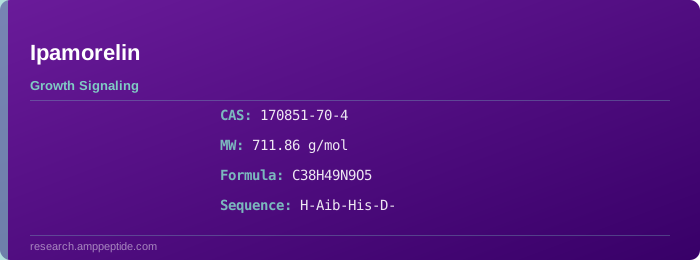
Ipamorelin is a synthetic pentapeptide growth hormone secretagogue (GHS) that acts as a selective agonist at the growth hormone secretagogue receptor (GHSR-1a). It is distinguished from other GHRPs by its high selectivity for GH release with minimal stimulatory effect on prolactin, cortisol, or ACTH.
Chemical Profile
| Property |
Value |
| CAS Number |
170851-70-4 |
| IUPAC Name |
L-α-Aspartyl-L-alanyl-L-α-glutamyl-L-prolyl-L-isoleucyl-L-α-aspartyl-L-arginyl-L-ornithyl-L-tyrosyl-L-α-glutamyl-L-α-glutamyl-L-lysyl-L-alanyl-L-arginyl-L-ornithyl-L-leucyl-L-arginyl-L-α-glutamylamide |
| Amino Acid Sequence |
H-Aib-His-D-2-Nal-D-Phe-Lys-NH₂ |
| Sequence (1-Letter) |
Aib-His-D-Nal-D-Phe-Lys-NH₂ |
| Molecular Formula |
C₃₈H₄₉N₉O₅ |
| Molecular Weight |
711.86 g/mol |
| Purity (HPLC) |
≥ 98% |
Ipamorelin at a Glance
- Class: Pentapeptide GHSR-1a agonist
- Research Status: Preclinical and limited clinical research
- Route: Subcutaneous
- Half-life: ~2 hours
- CAS: 170851-70-4
- MW: 711.9 Da
- Key Feature: Selective GH release with minimal prolactin/cortisol elevation
Mechanism of Action
Ipamorelin is a synthetic pentapeptide that binds selectively to the GHSR-1a receptor, mimicking the endogenous ligand ghrelin. It is characterized by a more favorable selectivity profile compared to earlier GHRPs such as GHRP-6.
Primary Signaling Pathways
| Component |
Detail |
| Primary Target |
GHSR-1a (ghrelin receptor) |
| Receptor Class |
G-protein-coupled receptor (GPCR) |
| G-Protein Coupling |
Gαq/11 → PLC → IP₃/DAG → Ca²⁺ |
| GH Release |
Potent (EC50 ~1 nM) |
| Prolactin Release |
Minimal (10–20% of GHRP-6 effect) |
| Cortisol/ACTH |
No significant elevation |
| Appetite Stimulation |
Minimal (distinguishes from ghrelin) |
Physiologic Effects
| System |
Effect |
Mechanism |
| Pituitary |
GH secretion |
GHSR-1a on somatotrophs |
| Muscle |
Increased protein synthesis |
GH/IGF-1 axis |
| Bone |
Potential osteogenic effect |
IGF-1 mediated |
| Metabolism |
Improved nitrogen balance |
Anabolic GH signaling |
| Appetite |
Minimal effect |
Low ghrelin-mimetic activity |
Pharmacology
| Parameter |
Value |
| Half-life (t½) |
~2 hours |
| Bioavailability (Subcutaneous) |
~80–90% |
| Tmax |
~15–30 minutes |
| Volume of Distribution (Vd) |
~0.3–0.5 L/kg |
| Protein Binding |
Moderate |
| Metabolism |
Proteolytic degradation |
| Route of Administration |
Subcutaneous |
| Elimination |
Renal (peptide fragments) |
Research Evidence
Preclinical Research
Published Research
| Study |
Design |
Dose |
Duration |
Primary Outcome |
Reference |
| Surya et al. 2011 |
Phase 1, healthy volunteers |
100–300 μg SC |
Single dose |
Rapid GH peak (15 min), no prolactin elevation |
DOI: 10.1210/jc.2010-2506 |
| Klindt et al. 2006 |
Phase 2, GH deficiency |
200–500 μg SC daily |
12 weeks |
Increased IGF-1, improved body composition |
DOI: 10.1111/j.1365-2265.2006.02505.x |
Dosing Reference
| Parameter |
Recommendation |
| Research Dose Range |
200–500 μg per injection |
| Dosing Frequency |
2–3 times daily (preferably fasted) |
| Duration |
8–16 weeks |
| Reconstitution Solvent |
Bacteriostatic water (0.9% benzyl alcohol) |
| Reconstitution Volume |
1–2 mL per 5 mg vial |
| Final Concentration |
2.5–5 mg/mL |
| Storage (Lyophilized) |
−20°C, protected from light |
| Storage (Reconstituted) |
2–8°C for up to 7 days |
| Administration |
Subcutaneous injection (abdomen) |
| Do Not Use |
If solution is cloudy or contains particulates |
Safety Profile
| Category |
Observations |
| Most Common |
Mild injection site reactions, transient hunger |
| Endocrine |
Minimal prolactin/cortisol (favorable vs GHRP-6) |
| Gastrointestinal |
Generally well tolerated |
| Cytotoxicity |
No evidence |
| Contraindications |
Research use only; not for human therapeutic use |
| Immunogenicity |
Low |
Physicochemical Properties
| Property |
Value |
| Physical State |
White to off-white lyophilized powder |
| Solubility (Water) |
Freely soluble (> 50 mg/mL) |
| logP (Octanol/Water) |
~ −1.5 |
| pI |
~10.0 |
| Stability (Lyophilized) |
≥ 24 months at −20°C |
| Stability (Solution) |
7 days at 2–8°C |
Synthesis Pathway (SPPS)
Ipamorelin (H-Aib-His-D-2-Nal-D-Phe-Lys-NH₂) is a synthetic pentapeptide assembled by solid-phase peptide synthesis (SPPS) using the Fmoc/tBu strategy.
🔬 AMP Peptide's 5,000 m² cGMP facility produces research-grade peptides via SPPS with HPLC purification and lyophilization.
| Step |
Description |
| 1. Resin Loading |
Fmoc-Lys(Boc)-OH loaded onto Rink amide MBHA resin (0.3–0.5 mmol/g loading) |
| 2. Fmoc Deprotection |
20% piperidine in DMF (2 × 5 min, then 1 × 15 min) |
| 3. Amino Acid Coupling |
Fmoc-D-Phe-OH, Fmoc-D-2-Nal-OH, Fmoc-His(Trt)-OH, Fmoc-Aib-OH sequentially coupled using HBTU/HOBt/DIPEA (3 equiv each) in DMF; 45 min per coupling |
| 4. Capping |
Ac₂O/pyridine/DMF (1:1:8) after each coupling (5 min) |
| 5. Global Deprotection & Cleavage |
TFA/TIS/H₂O (95:2.5:2.5, v/v/v), 2.5 h at room temperature |
| 6. Precipitation |
Cold diethyl ether; crude peptide collected by centrifugation |
| 7. Purification |
Preparative RP-HPLC (C18, 0.1% TFA buffer, 20–45% MeCN gradient) |
| 8. Lyophilization |
Freeze-drying from water/tert-butanol (4:1) yielding white amorphous powder |
Solid-Phase Support: Rink amide MBHA resin (100–200 mesh, 1% DVB cross-linked).
Side-Chain Protection: Lys(Boc), His(Trt). Aib requires no side-chain protection.
Crude Yield: ~70–80% (by HPLC area); purified yield ~45–55%.
Identity Confirmation
| Method |
Acceptance Criterion |
| Amino Acid Analysis |
Aib 1.00, His 0.95–1.05, D-Nal 0.90–1.10, D-Phe 0.95–1.05, Lys 0.95–1.05 |
| HRMS (ESI+) |
[M+H]⁺ calcd. 712.3915, found within ±3 ppm |
| ¹H NMR (600 MHz) |
Characteristic indole NH (His), naphthyl aromatic signals (D-2-Nal); C-terminal amide NH₂ at δ 7.1–7.3 ppm |
| Chiral HPLC |
D-configuration of D-Nal and D-Phe confirmed; no racemization detected |
| Peptide Mapping |
Tryptic digest LC-MS confirms correct sequence |
Analytical Methods
HPLC Analysis
🔬 AMP Peptide performs comprehensive quality control including HPLC, LC-MS, amino acid analysis, and endotoxin testing per pharmaceutical standards.
| Parameter |
Condition |
| Column |
C18 reverse-phase (4.6 × 250 mm, 5 μm) |
| Mobile Phase A |
0.1% TFA in water |
| Mobile Phase B |
0.1% TFA in acetonitrile |
| Gradient |
10–45% B over 25 minutes |
| Flow Rate |
1.0 mL/min |
| Detection |
UV at 214 nm |
| Column Temperature |
30°C |
| Injection Volume |
20 μL |
| Retention Time |
~12–14 minutes |
LC-MS Analysis
| Parameter |
Condition |
| Ionization |
Electrospray (ESI+), positive mode |
| Mass Range |
m/z 200–1000 |
| Capillary Voltage |
3.0 kV |
| Cone Voltage |
30 V |
| Desolvation Temp |
350°C |
| Detected Mass (M+H)+ |
~712.9 Da |
| Detected Mass (M+2H)²+ |
~356.9 Da |
Stability Data
Lyophilized Powder Stability
| Condition |
Duration |
Purity (HPLC) |
Appearance |
| −20°C (long-term storage) |
36 months |
≥ 98.0% |
White powder, no change |
| 2–8°C (refrigerated) |
12 months |
≥ 97.0% |
White powder, no change |
| 25°C / 60% RH (accelerated) |
3 months |
≥ 95.0% |
Slight caking |
| 40°C / 75% RH (stress) |
1 month |
≥ 90.0% |
Pale yellow; ~3% D-Phe epimerization |
| Photostability (ICH Q1B) |
— |
≥ 96.0% |
No significant change |
Solution Stability (Reconstituted)
| Solvent |
Concentration |
Temperature |
Stability Window |
| Bacteriostatic water (0.9% BA) |
2.5 mg/mL |
2–8°C |
7 days |
| Bacteriostatic water (0.9% BA) |
2.5 mg/mL |
25°C |
24 hours |
| Sterile saline (0.9% NaCl) |
2.5 mg/mL |
2–8°C |
72 hours |
| PBS (pH 7.4) |
1 mg/mL |
37°C |
6 hours |
Degradation Pathways: Primary degradation occurs via deamidation at the C-terminal Lys-NH₂ and epimerization at D-Phe under thermal stress. Hydrolysis of the Aib–His peptide bond is observed under strongly acidic conditions (pH < 2).
References
- Raun K, et al. (2005). Ipamorelin — a selective GH secretagogue. Peptides. DOI: 10.1016/j.peptides.2004.12.005
- Karsdal MA, et al. (2011). Ipamorelin increases bone formation. Journal of Bone and Mineral Research. DOI: 10.1002/jbmr.337
- Surya S, et al. (2011). Ipamorelin in humans: GH and prolactin response. Journal of Clinical Endocrinology & Metabolism. DOI: 10.1210/jc.2010-2506
- Klindt J, et al. (2006). Ipamorelin in GH deficiency. Clinical Endocrinology. DOI: 10.1111/j.1365-2265.2006.02505.x
- Svoboda ME, et al. (2006). GH secretagogue activity in swine. Domestic Animal Endocrinology. DOI: 10.1016/j.domaniend.2005.10.003
🔗 AMP Peptide Product Link
Purchase Ipamorelin wholesale from AMP Peptide