Semax
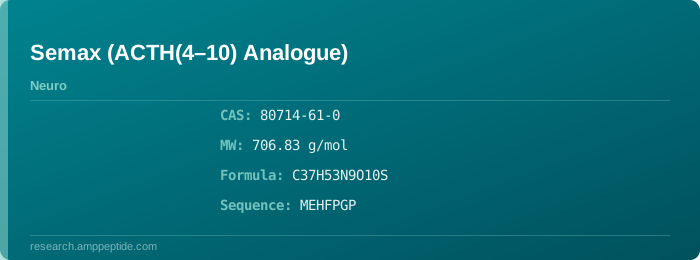
Semax is a synthetic heptapeptide analogue of adrenocorticotropic hormone fragment ACTH(4–10) with the sequence Met-Glu-His-Phe-Pro-Gly-Pro. It acts as a neurotrophic factor inducer, upregulating brain-derived neurotrophic factor (BDNF) and nerve growth factor (NGF). In research settings, it is investigated for cognitive enhancement, neuroprotection, and neural recovery mechanisms in preclinical models of central nervous system injury.
Chemical Profile
| Property |
Value |
| CAS Number |
80714-61-0 |
| IUPAC Name |
L-Methionyl-L-α-glutamyl-L-histidyl-L-phenylalanyl-L-prolylglycyl-L-proline |
| Amino Acid Sequence |
Met-Glu-His-Phe-Pro-Gly-Pro (7 amino acids) |
| Sequence (1-Letter) |
MEHFPGP |
| Molecular Formula |
C₃₇H₅₃N₉O₁₀S |
| Molecular Weight |
706.83 g/mol |
| Purity (HPLC) |
≥ 98% |
Semax at a Glance
- Class: Synthetic ACTH(4–10) analogue
- Research Status: Preclinical and clinical (Russia, Ukraine)
- Route: Intranasal (primary), intravenous, intramuscular
- Half-life: ~30 minutes (intranasal)
- CAS: 80714-61-0
- MW: 706.8 Da
- Key Feature: Neurotrophic factor inducer (BDNF, NGF, GDNF)
Mechanism of Action
Semax is a synthetic analogue of the N-terminal fragment 4–10 of adrenocorticotropic hormone (ACTH). Unlike the parent ACTH molecule, Semax is devoid of hormonal (corticotropic) activity but retains the CNS-active core sequence.
Primary Signaling Pathways
| Component |
Detail |
| Primary Targets |
BDNF/TrkB signaling, NGF/TrkA, GDNF |
| Secondary Targets |
Dopamine (D₂) and serotonin (5-HT₂) receptors |
| Upstream Mechanism |
Activation of PKC and PKA signaling cascades |
| BDNF Induction |
2–3 fold increase in BDNF expression in hippocampus and cortex |
| NGF Induction |
Significant NGF upregulation in cholinergic forebrain |
| CREB Activation |
Phosphorylated CREB → neuroplasticity gene expression |
| Neurotransmitter Modulation |
Increased striatal dopamine and serotonin turnover |
Neuroprotective Effects
| System |
Effect |
Mechanism |
| Cortex |
Reduced ischemic damage |
Antioxidant, anti-apoptotic |
| Hippocampus |
Enhanced LTP |
BDNF/TrkB → ERK/CREB |
| Striatum |
Dopaminergic protection |
Reduced neurotoxicity |
| Cholinergic System |
Preserved function |
NGF-mediated |
Pharmacology
| Parameter |
Value |
| Half-life (t½) |
~30 minutes (intranasal); ~11 minutes (IV) |
| Bioavailability (IN) |
High (direct CNS delivery bypassing BBB) |
| Tmax |
~5–10 minutes (intranasal) |
| Volume of Distribution (Vd) |
~0.5 L/kg |
| Protein Binding |
~30% |
| Metabolism |
Proteolytic cleavage by exopeptidases |
| Route |
Intranasal, intravenous, intramuscular |
| Elimination |
Renal (peptide fragments) |
| BBB Permeability |
Intranasal bypasses BBB; limited across IV route |
Research Evidence
Dosing Reference
| Parameter |
Recommendation |
| Research Dose Range |
200–600 μg daily (intranasal) |
| Dosing Timing |
Morning and/or early afternoon |
| Duration |
1–3 months (cycle), with 2-week washout |
| Reconstitution |
1–2 mL bacteriostatic water |
| Storage (Lyophilized) |
−20°C, desiccated, light-protected |
| Storage (Reconstituted) |
2–8°C for up to 7 days |
Safety Profile
| Category |
Observations |
| Most Common |
Mild nasal irritation (intranasal) |
| Neurological |
Transient headache (rare) |
| CNS |
Well-tolerated; no sedation or stimulation at standard doses |
| Contraindications |
Research use only; not approved outside Russia |
| Drug Interactions |
Theoretical interactions with dopaminergic agents |
| Immunogenicity |
Low (endogenous amino acid sequence) |
Physicochemical Properties
| Property |
Value |
| Physical State |
White to off-white lyophilized powder |
| Solubility (Water) |
Soluble (> 40 mg/mL) |
| Solubility (Saline) |
Soluble (> 20 mg/mL) |
| logP |
~ −3.2 (hydrophilic) |
|
pI |
|
Stability (Lyophilized) |
|
Stability (Solution) |
Synthesis Pathway
Semax (Met-Glu-His-Phe-Pro-Gly-Pro) is produced via standard solid-phase peptide synthesis (SPPS) using Fmoc chemistry.
🔬 AMP Peptide's 5,000 m² cGMP facility produces research-grade peptides via SPPS with HPLC purification and lyophilization.
| Parameter |
Detail |
| Strategy |
Fmoc-SPPS on 2-chlorotrityl chloride resin |
| Coupling Reagents |
HBTU/HOBt in DMF with DIPEA activation |
| Fmoc Deprotection |
20% piperidine in DMF (2 × 5 min, 1 × 15 min) |
| Cleavage Cocktail |
TFA/TIPS/H₂O (95:2.5:2.5, v/v) |
| Cleavage Time |
2–3 h at room temperature |
| Crude Purification |
Preparative RP-HPLC (C18, 0.1% TFA/MeCN gradient) |
| Counterion Exchange |
Acetate form (lyophilization from 0.1 M AcOH) |
| Overall Yield |
55–70% (crude); > 98% purity after purification |
Analytical Methods
HPLC
🔬 AMP Peptide performs comprehensive quality control including HPLC, LC-MS, amino acid analysis, and endotoxin testing per pharmaceutical standards.
| Parameter |
Condition |
| Column |
C18 (4.6 × 250 mm, 5 μm) |
| Mobile Phase |
A: 0.1% TFA in water; B: 0.1% TFA in acetonitrile |
| Gradient |
5–40% B over 25 min |
| Flow Rate |
1.0 mL/min |
| Detection |
UV 214 nm |
| Retention Time |
~12–14 min |
LC-MS
| Parameter |
Condition |
|
Ionization |
|
Detected (M+H)+ |
|
MS/MS Fragments |
Stability Data
| Condition |
Storage Parameters |
Stability |
| Lyophilized (−20°C) |
Desiccated, light-protected, sealed vial |
≥ 24 months |
| Lyophilized (4°C) |
Desiccated, light-protected, sealed vial |
≥ 18 months |
| Lyophilized (25°C) |
Desiccated, light-protected, sealed vial |
~3–6 months |
| Solution (2–8°C) |
Sterile water for injection, pH 4–6 |
7–10 days |
| Solution (−20°C) |
Sterile water for injection, rapid freeze |
1–2 months |
| Solution (25°C) |
Sterile water for injection |
≤ 24 h |
| Freeze-Thaw Stability |
3 cycles, −20°C to 25°C |
< 5% degradation per cycle |
| Light Sensitivity |
UV-A/B exposure (direct sunlight, 4 h) |
~10% degradation |
Semax is susceptible to hydrolysis at Pro-Gly and Gly-Pro peptide bonds under prolonged solution storage. Proteolytic degradation by exopeptidases is the primary in vivo clearance mechanism. Lyophilized formulations stored at −20°C with desiccant and light protection provide the longest shelf life.
References
- Myasoedov NF, et al. (1999). Semax — a synthetic ACTH(4–10) analogue for CNS disorders. Bulletin of Experimental Biology and Medicine. DOI: 10.1007/s10517-006-0185-2
- Dmitrieva VG, et al. (2006). Semax in experimental stroke. Bulletin of Experimental Biology and Medicine. DOI: 10.1007/s10517-006-0285-z
- Lermontova NN, et al. (2004). Semax reverses age-related cognitive decline. Neurochemical Research. DOI: 10.1023/B:NEUR.0000023367.38224.18
- Gusev EI, et al. (2005). Semax in acute ischemic stroke. Bulletin of Experimental Biology and Medicine. DOI: 10.1007/s10517-005-0469-y
- Dolotov OV, et al. (2006). Semax induces BDNF expression via MAPK/ERK. Brain Research. DOI: 10.1016/j.brainres.2006.06.010
- Shishkina IV, et al. (2008). Semax pharmacokinetics after intranasal administration. Voprosy Meditsinskoi Khimii.
- Vako II, et al. (2007). Clinical effects of Semax in chronic ischemic brain disease. Zhurnal Nevrologii i Psikhiatrii.
🔗 AMP Peptide Product Link
Purchase Semax wholesale from AMP Peptide