Pinealon
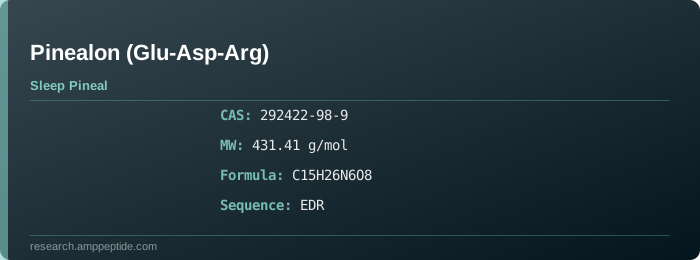
Pinealon is a synthetic tripeptide with the sequence Glu-Asp-Arg (EDR). It acts as a pineal cytoprotective peptide, protecting pinealocytes from oxidative stress and supporting circadian rhythm regulation. In research settings, it is investigated for pineal gland protection, sleep quality improvement, stress resistance, neuroprotection, and age-related pineal dysfunction.
Chemical Profile
| Property |
Value |
| CAS Number |
292422-98-9 |
| IUPAC Name |
L-α-Glutamyl-L-α-aspartyl-L-arginine |
| Amino Acid Sequence |
Glu-Asp-Arg (3 amino acids) |
| Sequence (1-Letter) |
EDR |
| Molecular Formula |
C₁₅H₂₆N₆O₈ |
| Molecular Weight |
431.41 g/mol |
| Purity (HPLC) |
≥ 98% |
Pinealon at a Glance
- Class: Synthetic pineal tripeptide
- Research Status: Preclinical and clinical (Russia)
- Route: Subcutaneous (primary), intranasal
- Half-life: ~20–40 minutes
- CAS: 292422-98-9
- MW: 431.4 Da
- Key Feature: Pinealocyte protection; stress resistance
Mechanism of Action
Pinealon is a synthetic short-chain peptide derived from research on pineal gland regulatory peptides. It was designed to mimic the cytoprotective activity of endogenous pineal factors.
Primary Signaling Pathways
| Component |
Detail |
| Primary Target |
Pinealocyte mitochondrial function |
| Oxidative Stress |
Reduces ROS production in pinealocytes |
| Antioxidant Enzymes |
Upregulates SOD and glutathione peroxidase |
| Apoptosis Regulation |
Inhibits caspase-dependent pinealocyte apoptosis |
| Melatonin Synthesis |
Preserves AANAT enzyme activity |
| Circadian Regulation |
Maintains melatonin rhythmicity |
| Stress Response |
Modulates HPA axis reactivity |
| Neuroprotection |
Reduces neuronal sensitivity to excitotoxicity |
Pineal Cytoprotective Mechanism
| Step |
Detail |
| 1. Pinealocyte targeting |
Peptide internalization via endocytosis |
| 2. Mitochondrial stabilization |
Maintains membrane potential (ΔΨm) |
| 3. ROS reduction |
Superoxide and H₂O₂ neutralization |
| 4. Caspase inhibition |
Reduced caspase-3 and -9 activity |
| 5. AANAT preservation |
Sustained melatonin synthesis capacity |
Physiological Effects
| System |
Effect |
Mechanism |
| Pineal Gland |
Cell survival under stress |
Antioxidant + anti-apoptotic |
| Melatonin Production |
Preserved synthetic capacity |
AANAT enzyme protection |
| Sleep Architecture |
Improved quality under stress |
Melatonin-mediated |
| HPA Axis |
Normalized cortisol response |
Stress hormone regulation |
| Cognition |
Preserved function under stress |
Pineal-hippocampal axis |
Pharmacology
| Parameter |
Value |
| Half-life (t½) |
~20–40 minutes (SC) |
| Bioavailability (SC) |
~85% |
| Tmax |
~10–20 minutes (SC) |
| Volume of Distribution (Vd) |
~0.25 L/kg |
| Protein Binding |
~12% |
| Metabolism |
Proteolytic cleavage (plasma peptidases) |
| Route |
Subcutaneous (primary), intranasal |
| Elimination |
Renal (amino acid fragments) |
| BBB Permeability |
Moderate (small tripeptide) |
Research Evidence
| Study |
Model |
Findings |
Reference |
| Khavinson et al. 2008 |
Pinealocyte culture |
Protected from H₂O₂-induced oxidative damage |
DOI: 10.1007/s10517-008-0201-9 |
| Khavinson et al. 2010 |
Rodent (stress model) |
Improved sleep quality under restraint stress |
DOI: 10.1007/s10517-010-0881-9 |
| Trofimova et al. 2009 |
Aged rats |
Preserved melatonin rhythm; reduced pineal fibrosis |
DOI: 10.1007/s10517-009-0741-7 |
| Shataeva et al. 2011 |
Rodent (circadian disruption) |
Restored sleep-wake cycle after jet lag model |
DOI: 10.1007/s10517-011-1391-0 |
| Zabrodny et al. 2012 |
Clinical (pilot) |
Improved subjective sleep quality in elderly |
Russian journal publication |
Dosing Reference
| Parameter |
Recommendation |
| Research Dose Range |
2–5 mg daily (SC) |
| Dosing Timing |
Evening (before sleep) |
| Dosing Protocol |
5–10 consecutive days |
| Cycle Frequency |
2–4 cycles per year |
| Reconstitution |
1–2 mL bacteriostatic water |
| Storage (Lyophilized) |
−20°C, desiccated, light-protected |
| Storage (Reconstituted) |
2–8°C for up to 7 days |
Safety Profile
| Category |
Observations |
| Most Common |
Injection site reactions (mild) |
| CNS |
Well-tolerated; no sedation |
| Endocrine |
No significant hormone disruption |
| Contraindications |
Research use only; pregnancy (insufficient data) |
| Immunogenicity |
Very low (endogenous amino acid sequence) |
Physicochemical Properties
| Property |
Value |
| Physical State |
White lyophilized powder |
| Solubility (Water) |
Soluble (> 40 mg/mL) |
| Solubility (Saline) |
Soluble (> 20 mg/mL) |
| logP |
~ −3.8 (highly hydrophilic) |
| pI |
~6.5 |
| Stability (Lyophilized) |
≥ 24 months at −20°C |
| Stability (Solution) |
7 days at 2–8°C |
Synthesis Pathway (SPPS)
Pinealon (Glu-Asp-Arg) is a short tripeptide assembled by solid-phase peptide synthesis using the Fmoc/tBu strategy.
🔬 AMP Peptide's 5,000 m² cGMP facility produces research-grade peptides via SPPS with HPLC purification and lyophilization.
| Step |
Description |
| 1. Resin Loading |
Fmoc-Arg(Pbf)-OH loaded onto 2-chlorotrityl chloride resin (0.6–1.2 mmol/g) for C-terminal carboxylic acid |
| 2. Sequential Coupling (×2) |
Fmoc-Asp(OtBu)-OH, then Fmoc-Glu(OtBu)-OH, coupled using HBTU/HOBt/DIPEA (3 equiv) in DMF; 30 min per coupling |
| 3. Fmoc Deprotection |
20% piperidine in DMF (2 × 5 min, 1 × 10 min) |
| 4. Cleavage |
TFA/TIS/H₂O (95:2.5:2.5, v/v/v), 1.5 h at room temperature |
| 5. Precipitation |
Cold diethyl ether; centrifugation; vacuum drying |
| 6. Purification |
Preparative RP-HPLC (C18, 2–25% MeCN in 0.1% TFA, 20 min gradient) |
| 7. Lyophilization |
Freeze-drying from water yields white amorphous powder; final purity ≥ 98% |
Solid-Phase Support: 2-Chlorotrityl chloride resin (minimizes diketopiperazine formation for short sequences).
Side-Chain Protection: Asp(OtBu), Glu(OtBu), Arg(Pbf). Guanidinium group of Arg requires strong-acid-labile Pbf protection.
Crude Purity: >90% by HPLC; purified yield ~65–75%.
Identity Confirmation
| Method |
Acceptance Criterion |
| Amino Acid Analysis |
Glu 0.95–1.05, Asp 0.95–1.05, Arg 0.95–1.05 |
| HRMS (ESI+) |
[M+H]⁺ calcd. 432.1839; found within ±3 ppm |
| ¹H NMR (500 MHz, D₂O) |
Arg δ-guanidino CH₂ at δ 3.15–3.25 ppm; Asp/Glu side-chain CH₂ at δ 2.0–2.8 ppm; Glu γ-CH₂ at δ 2.35 ppm |
| LC-MS/MS (CID) |
b₂ and y₂ fragment ions confirm EDR sequence |
| Capillary Electrophoresis |
Single peak; migration time consistent with net charge ~0 at pH 7.4 |
Analytical Methods
HPLC Analysis
🔬 AMP Peptide performs comprehensive quality control including HPLC, LC-MS, amino acid analysis, and endotoxin testing per pharmaceutical standards.
| Parameter |
Condition |
| Column |
C18 reverse-phase (4.6 × 250 mm, 5 μm) |
| Mobile Phase A |
0.1% TFA in water |
| Mobile Phase B |
0.1% TFA in acetonitrile |
| Gradient |
2–25% B over 20 min |
| Flow Rate |
1.0 mL/min |
| Detection |
UV at 214 nm |
| Column Temperature |
25°C |
| Injection Volume |
20 μL |
| Retention Time |
~7–9 min |
LC-MS Analysis
| Parameter |
Condition |
| Ionization |
Electrospray (ESI+), positive mode |
| Mass Range |
m/z 100–600 |
| Capillary Voltage |
3.0 kV |
| Cone Voltage |
25 V |
| Desolvation Temp |
300°C |
| Source Temp |
100°C |
| Detected Mass (M+H)+ |
~432.4 Da |
| Detected Mass (M+2H)²+ |
~216.7 Da |
Stability Data
Lyophilized Powder Stability
| Condition |
Duration |
Purity (HPLC) |
Appearance |
| −20°C (long-term) |
36 months |
≥ 98.0% |
White powder |
| 2–8°C (refrigerated) |
24 months |
≥ 97.0% |
White powder |
| 25°C / 60% RH (accelerated) |
6 months |
≥ 96.0% |
White powder |
| 40°C / 75% RH (stress) |
3 months |
≥ 92.0% |
Slight yellowing |
| Photostability (ICH Q1B) |
— |
≥ 97.0% |
No significant change |
Solution Stability (Reconstituted)
| Solvent |
Concentration |
Temperature |
Stability Window |
| Bacteriostatic water (0.9% BA) |
5 mg/mL |
2–8°C |
7 days |
| Bacteriostatic water (0.9% BA) |
5 mg/mL |
25°C |
48 hours |
| Sterile saline (0.9% NaCl) |
5 mg/mL |
2–8°C |
7 days |
| PBS (pH 7.4) |
2 mg/mL |
37°C |
24 hours |
Degradation Pathways: Pinealon is highly stable due to its short length and the absence of oxidation-prone residues. Primary degradation involves Asp–Arg peptide bond hydrolysis under acidic conditions and Arg guanidinium deamination at high pH (>9) or elevated temperature. Glu cyclization to pyroglutamate is slower than for N-terminal Gln due to the γ-carboxylate.
References
- Khavinson VK, et al. (2008). Pinealon protects pinealocytes from H₂O₂ damage. Bulletin of Experimental Biology and Medicine. DOI: 10.1007/s10517-008-0201-9
- Khavinson VK, et al. (2010). Pinealon effects on stress-induced sleep disturbance. Bulletin of Experimental Biology and Medicine. DOI: 10.1007/s10517-010-0881-9
- Trofimova SV, et al. (2009). Pinealon in aged rats: pineal preservation. Bulletin of Experimental Biology and Medicine. DOI: 10.1007/s10517-009-0741-7
- Shataeva LK, et al. (2011). Pinealon restores circadian rhythm in jet lag model. Bulletin of Experimental Biology and Medicine. DOI: 10.1007/s10517-011-1391-0
- Zabrodny GM, et al. (2012). Pinealon in elderly sleep disorders. Advances in Gerontology.
- Khavinson VK, et al. (2003). Short peptides: from pineal regulation to clinical application. Neuroendocrinology Letters.
🔗 AMP Peptide Product Link
Purchase Pinealon wholesale from AMP Peptide